
30 October 2023, 07:05
-
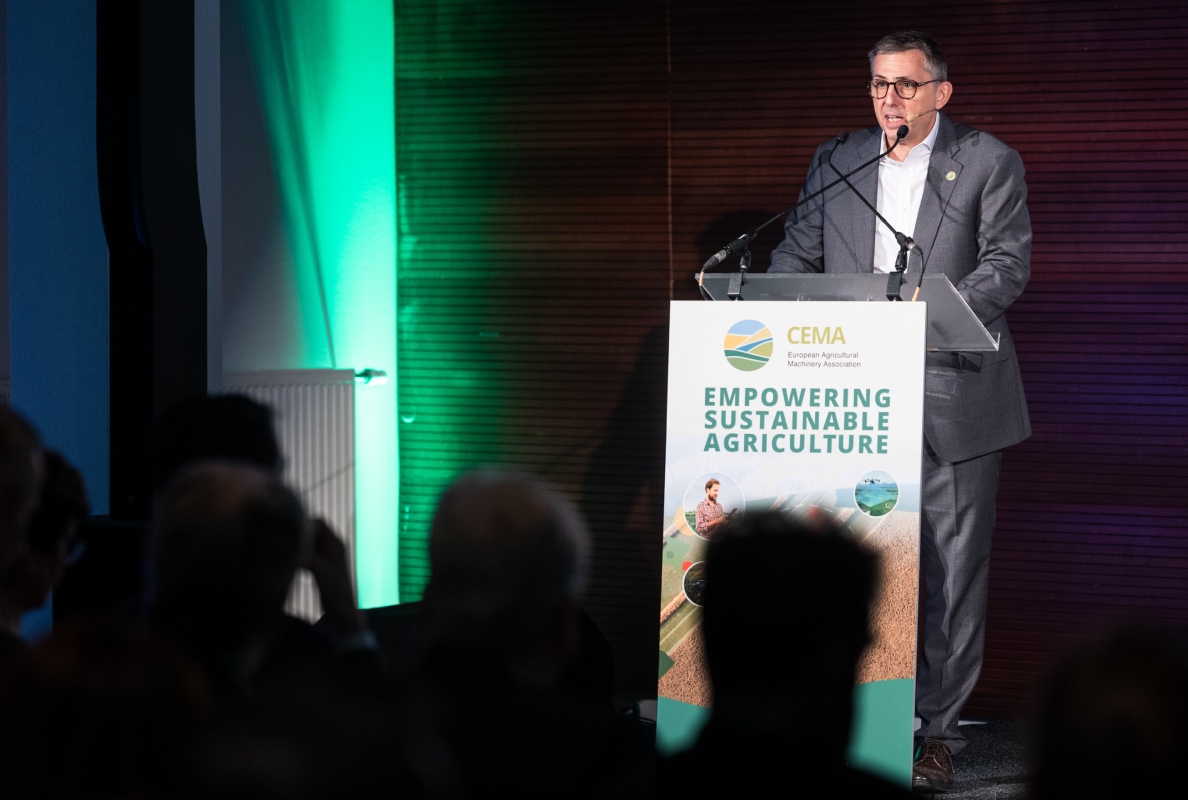
The European Agricultural Machinery Industry Association (CEMA) held its "Empowering Sustainable Agriculture" Summit in Brussels, with over 160 participants from industry, academia, and stakeholder groups. The event focused on the challenges of food security, farmer profitability, and sustainability in agriculture.
-
CEMA President Thierry Krier emphasized the need for tailor-made technologies to make farming practices more sustainable. He also stressed the need for specific legislation to support manufacturers in serving the diverse needs of European farmers.
-
Maciej Golubiewski, Head of Cabinet of European Commissioner for Agriculture, highlighted the role of advanced technologies and digitalization in strengthening the competitiveness and resilience of European agriculture. He emphasized the importance of scalability and user-oriented innovations.
-
The Summit featured high-level speakers from the European Institutions and the agricultural machinery industry, discussing the role of the Common Agricultural Policy in fostering technological transition and the need to scale up sustainability efforts.
-
The event also included in-depth panel discussions on the four sub-topics of Robotics and AI, Soil health, Renewable and low-carbon fuels, and Precision agriculture.
-
For the first time, CEMA organized an "Innovation Village", showcasing how agricultural machinery manufacturers develop innovative solutions to serve farmers today and tomorrow.
Sustainability, food security and farmer profitability can be reached through innovative technologies, but specific legislation is needed.
Advertisement
On 23rd and 24th October CEMA, the European Agricultural Machinery Industry Association held its Summit in Brussels. The event, titled “Empowering Sustainable Agriculture”, over the course of the two days brought together over 160 participants from industry, the European institutions, academia, and stakeholder groups.
The CEMA Summit wasthe occasion for the farm machinery industry to present its analysis of the agricultural world. CEMA President Thierry Krier (CEO and President of KUHN Group) outlined the three main challenges agriculture is facing: food security, farmers profitability, sustainability. While the industry does not claim to have all the answers to address them, machinery manufacturers listen to and work alongside farmers daily to provide them with tailor-made technologies to make their farming practices more sustainable with the use of technological solutions. These solutions are adapted and customized to the need of the farmers, who are varied and diverse, reflecting the diversity in European farming. For manufacturers to serve farmers, specific legislation needs to be put in place, as one-size does not fit-all in this case.
The role of agricultural machinery’s advanced technologies and digitalization was also underlined by Maciej Golubiewski, Head of Cabinet of European Commissioner for Agriculture Mr. Janusz Wojciechowski. “Digital solutions,” he said, “can help us reinforce the competitiveness of European agriculture while strengthening its resilience”, putting at the centre the importance of scalability and user-oriented innovations. Farmers’ centrality was brought forward by Christiane Lambert, President of COPA, who highlighted the significance of their contribution as the implementers of the green transition, and their willingness to do their part.
The CEMA Summit saw the presence of high-level speakers, both from the European Institutions such as Chairman of the AGRI Committee MEP Norbert Lins, Catherine Geslain-Lanéelle from DG Agri, MEP Jan Huitema. Panellists discussed the role of the Common Agricultural Policy in fostering the technological transition for European agriculture, but also reflected on the other instruments available. When it comes to sustainability, said Geslain-Lanéelle, “the transition has started, but it needs to be scaled up”.
Rabobank analyst Doriana Milenkova framed the importance of farming practicesin the green transition. The agricultural machinery industry was also represented by important members: Carlo Lambro from CNH Industrial, Walter Wagner from AGCO/Fendt and Mark von Pentz from John Deere. These speakers brought their extensive experience and expertise on the stage to discuss the options on the table for European farmers when it comes to energy, what solutions the sector is offering technologically to support them, but also how the general international context and markets affect this access to energy. To complete the framework was Eric Quenet from TotalEnergies, who brought an energy provider perspective.
The second day of the event was also rich, with interventions by the Secretary General of the Ministry of Agriculture of Spain, Fernando Miranda Sotillos, as well as an overview of the market trends and uncertainties of sustainable productivity by Tassos Haniotis (Senior Guest Researcher for IIASA, and former Director of Strategy & Policy Analysis at the European Commission DG for Agri). In-depth panel discussions with experts were held on the four sub-topics of the CEMA Summit: Robotics and AI, Soil health, Renewable and low-carbon fuels, Precision agriculture.
For the first time CEMA also organized an “Innovation Village”, where 9 partners and 7 sponsors teamed up to showcase how agricultural machinery manufacturers work to develop innovative and better solutions to provide practical, readily available solutions to serve farmers today and tomorrow, bringing their machines and their concepts to Brussels.
Source: CEMA aisbl
Set LECTURA Press as your preferred source
