

3 April 2025, 08:35
-
Up to 96% of the energy used in producing compressed air can be reused as heat through heat recovery systems.
-
Air- and water-cooled rotary screw compressors are highly efficient for heat recovery, transferring 76% of energy to the cooling medium and 15% to compressed air.
-
Modern rotary screw compressors can recover 96% of electrical drive energy for heating purposes, with minimal energy loss.
-
The simplest heat recovery method involves using heated cooling air to heat nearby storage rooms or workshops.
-
Reusable compressor heat can also be integrated into hot water heating systems using plate heat exchangers, achieving 70-80% efficiency.
-
Heat recovery systems enhance compressed air system efficiency and reduce greenhouse gas emissions, with investment costs varying by installation environment and application.
Compressor operators have a distinct advantage when it comes to reducing energy consumption and costs, because the savings are already there for the taking. The key to this potential ‘gold mine’ lies in heat recovery – up to 96 percent of the energy that is used to produce compressed air remains available for reuse as heat.
Advertisement
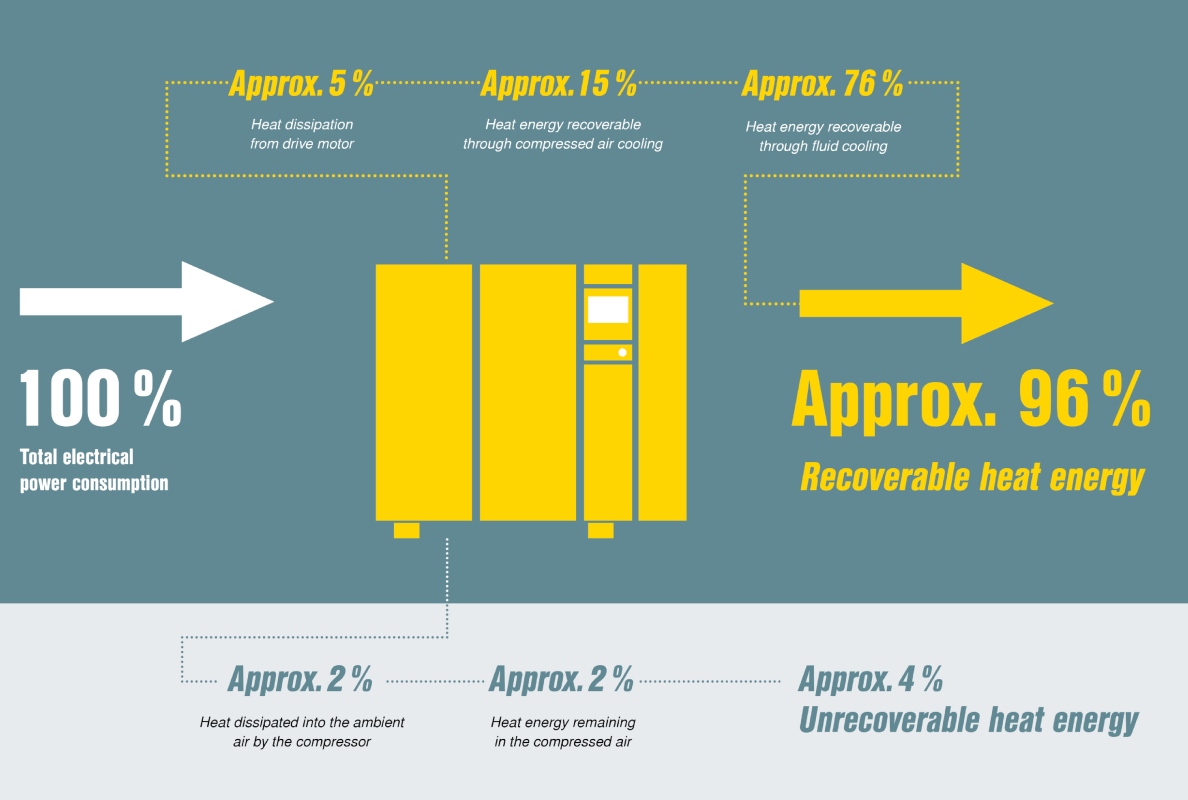
100 percent of the drive energy fed to a compressor is converted into heat. Air- and water-cooled rotary screw compressors are the best-suited compressor technologies for efficient heat recovery. The greatest part of the energy consumed by these compressors, some 76 percent, is transferred to the cooling medium. A further 15 percent is transferred to the compressed air, and heat losses from the electrical motor account for up to 5 percent. Modern, fully-encapsulated rotary screw compressors can use targeted cooling to recover this energy. In total therefore, 96 percent of the electrical drive energy fed to the compressor can be reused for heating purposes. Only about 2 percent of the energy is lost as radiant heat and about 2 percent remains as heat in the compressed air.
The most efficient and also the simplest method of heat recovery with rotary screw compressors is to directly use the cooling air that has been heated by the compressor. Air ducts feed the warmed cooling air into nearby store rooms or workshops. If there is no heat demand then the surplus heat is simply released to atmosphere via a damper or louvres. Thermostatically controlled, motorised dampers control the flow of warm air to maintain consistent room temperatures. In addition to providing heating or heating support for operating or storage areas, the recyclable heat can also be used – for example – to support drying processes, to create hot air curtains, or to preheat burner combustion air for heating systems (to increase efficiency). The associated investment costs are often amortised within a year.
Reusable compressor heat can also be fed into the hot water heating and service water systems. The most cost effective way of doing so is with plate heat exchangers. The heat exchanger is connected to the compressor‘s cooling circulation system and transfers energy from the warm coolant to the water which is to be heated. Depending on whether the hot water is to be used for heating purposes, as showering or washing water, or for sensitive production and cleaning processes, fail-safe heat exchangers may also be used in conjunction with plate heat exchangers. Using these heat exchangers, some 70 to 80 percent of the installed compressor power can be used for heating purposes without the need for any additional energy consumption. This method of heat recovery can also be used with primarily water-cooled rotary screw compressors.
Heat recovery not only significantly enhances compressed air system efficiency, but also benefits the environment by preventing unnecessary greenhouse gas emissions. The amount of investment required is dictated by the onsite installation environment, the application and the chosen method of heat recovery.
Source: KAESER KOMPRESSOREN SE
Set LECTURA Press as your preferred source