
25 November 2026, 09:22
-
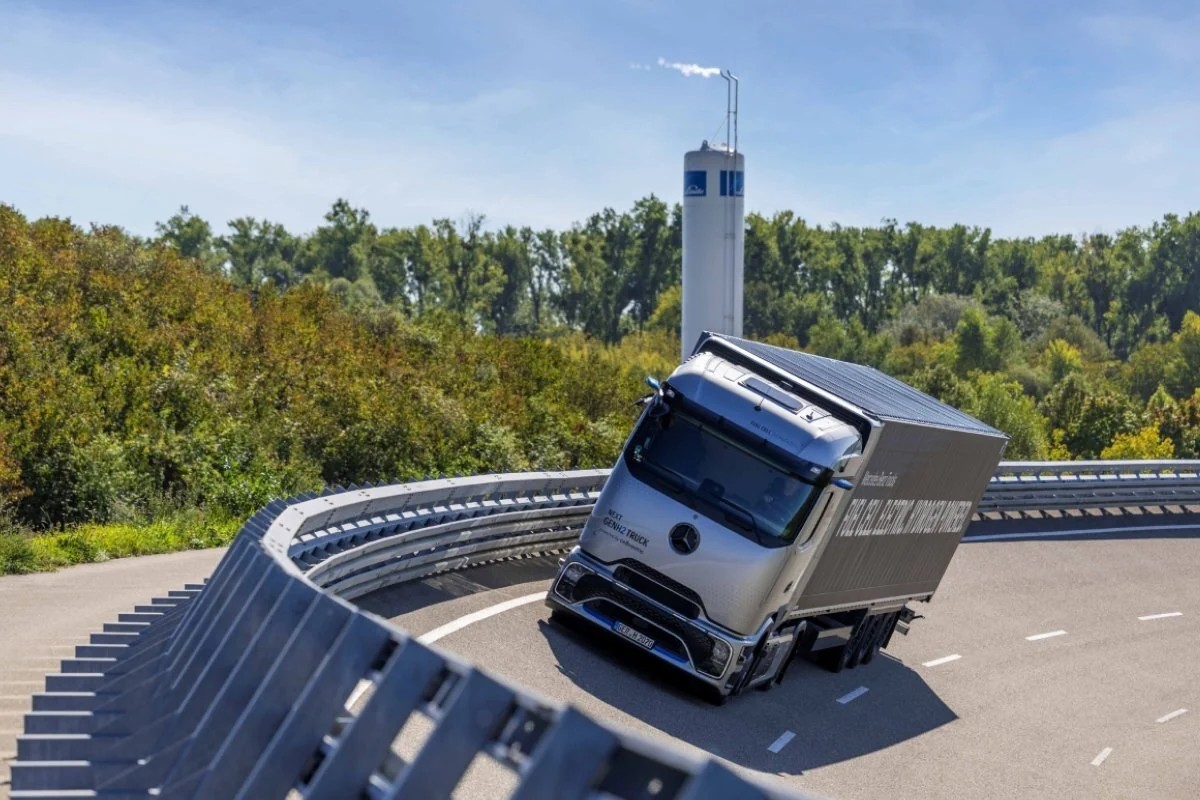
Daimler Truck's Mercedes-Benz NextGenH2 Truck uses liquid hydrogen fuel cells, offering high energy density for ranges exceeding 1,000 kilometers and fast refueling within 10-15 minutes.
-
Customer trials with the first-generation GenH2 Truck have logged over 600,000 kilometers, demonstrating integration into regular logistics operations.
-
Small series production of 100 NextGenH2 Trucks will begin in 2027, focusing on heavy-duty long-haul transport with optimized payload and operational flexibility.
-
Expansion of liquid hydrogen refueling infrastructure and a joint industry initiative are critical to scaling adoption and achieving cost-effective operations.
For the decarbonization of road freight transport, Daimler Truck is pursuing a dual strategy with battery-electric and hydrogen-based drives. In developing its fuel cell trucks, the Daimler Truck segment Mercedes-Benz Trucks is focusing on liquid hydrogen. The decisive factors are, in particular, the high energy density relative to storage volume and the properties of the tank system. For the Mercedes-Benz NextGenH2 Truck, which is set to be produced in a small series of 100 vehicles at the Wörth am Rhein plant from 2027, this approach enables a large amount of energy to be carried on board for demanding applications in heavy-duty long-haul transport. In addition, refueling times are short.
Liquid hydrogen in the NextGenH2 Truck: Technical properties and benefits in long-haul transport
Advertisement
The following aspects show the significance of the storage properties of liquid hydrogen and the tank system for range, refueling, payload, and operational planning.
1. High energy density relative to storage volume
Liquid hydrogen is stored at around −253 degrees Celsius. Compared with batteries and gaseous compressed hydrogen, it has a higher energy density relative to storage volume. This makes it possible to carry comparatively more energy within the limited installation space of a heavy-duty truck. The NextGenH2 Truck has a tank capacity of up to 85 kilograms of liquid hydrogen.
2. Long range for demanding operations
The large amount of energy carried on board forms the basis for long ranges: The NextGenH2 Truck enables a range of well over 1,000 kilometers on a single tank filling with a full load. The previous generation already demonstrated the range potential of liquid hydrogen during the #HydrogenRecordRun in September 2023. In this run, a Mercedes-Benz GenH2 Truck, the predecessor of the NextGenH2 Truck, covered 1,047 kilometers with a gross combination weight of around 40 metric tons on a single filling of the liquid energy carrier.
3. Short refueling stops thanks to the ISO 13984 refueling standard
For refueling with liquid hydrogen, Daimler Truck co-developed the ISO 13984 refueling standard within an ISO working group. This allows a 40-metric-ton truck such as the NextGenH2 Truck to be fully refueled within 10 to 15 minutes. For transport companies, short refueling stops are an important factor for fleet deployment planning and vehicle availability, particularly in long-haul transport.
4. Weight of the tank system and installation space requirements
Compared with batteries, the liquid hydrogen tank system offers advantages primarily in terms of weight. A lower tank system weight can benefit payload. However, the payload of the vehicle as a whole also depends on the respective vehicle configuration and the other drivetrain components. In addition, for a comparable range, installing the liquid hydrogen tank system requires significantly less installation space than installing a system for gaseous compressed hydrogen.
5. Integration into existing logistics operations
For transport companies, what counts is how range, refueling times, and payload interact in day-to-day operations. Long ranges and short refueling stops can support vehicle dispatching, particularly on long-haul routes that are difficult to plan, with high daily mileages, and for time-critical transports. They can help limit refueling-related downtime and create flexibility in operational planning. In terms of range and the duration of refueling stops, operations can thus be based on the familiar routines of a diesel truck. The prerequisite is that suitable liquid hydrogen refueling stations are reliably available along the planned routes.
From customer trials to the NextGenH2 Truck
The customer trials show how these properties perform in everyday operations. Since summer 2024, five first-generation Mercedes-Benz GenH2 Trucks have been undergoing trials with ten customers in various logistics applications. The hydrogen-powered vehicles have already covered well over 600,000 kilometers. Experience to date shows that fuel cell trucks with long ranges and fast refueling can, in principle, be integrated into regular logistics operations. For the participating customers, the focus is on concrete questions of day-to-day operations – from vehicle deployment planning and refueling to reliability in different transport tasks. The findings are being fed into further vehicle development as well as into the preparation of sales and service. At the same time, they help to further align the vehicle, refueling, service, and fleet planning with one another.
From 2027, the new Mercedes-Benz NextGenH2 Truck is set to enter customer operations in a small series of 100 vehicles. Interest is high: Almost half of the small series has already been allocated, despite the still limited refueling infrastructure. The focus is on the concrete benefits for defined applications: a large amount of energy on board, long range, short refueling stops, and a payload suitable for heavy-duty long-haul transport. A suitable operating profile and a reliably available liquid hydrogen infrastructure create the conditions for making the best possible use of this potential in the respective operation.
Infrastructure and cost-effectiveness will determine scaling
The strengths of liquid hydrogen are evident not only in the vehicle, but along the entire supply chain – from transport and the refueling station to costs. The high energy density of liquid hydrogen also has an impact on supplying refueling stations: A 40-metric-ton tanker truck already transports 3.9 metric tons of liquid hydrogen today – enough for around 45 complete truck refuelings. The flexibility of liquid hydrogen is also evident at the refueling station: A liquid hydrogen station can serve vehicles with all tank systems. In addition, the refueling station’s electricity requirement for liquid hydrogen is low, as energy-intensive compression on site is not necessary. The sLH₂ pilot station for subcooled liquid hydrogen in Wörth am Rhein, jointly developed by Daimler Truck and Linde, requires around 0.05 kilowatt-hours per kilogram. This can result in an advantage in terms of investment and operating costs.
However, current operations still take place on defined routes and with refueling options in Wörth am Rhein and the Duisburg area. For broader use of liquid hydrogen trucks, the corresponding supply must grow accordingly. The currently still limited availability of suitable liquid hydrogen refueling stations is a key limiting factor.
Joint initiative for the hydrogen ramp-up
An initiative by Daimler Truck, Volvo Group, Toyota Motor Corporation, Bosch, Air Liquide, TotalEnergies, TEAL Mobility, and MB Energy, presented at IAA Transportation 2026 in Hanover, addresses the ramp-up of hydrogen-powered commercial vehicles as a whole. Together, the companies aim to more closely align vehicle offerings, hydrogen supply, and refueling infrastructure along the entire value chain.
Plans include developing hydrogen refueling stations along strategically important European transport corridors in parallel with the ramp-up of vehicle fleets, and making hydrogen available at competitive prices.
For customers, a coordinated development of vehicle offerings and supply can facilitate operational planning, reduce detours and unproductive downtime, and create greater planning certainty for investment decisions. For the deployment of the NextGenH2 Truck, what specifically matters is the availability of suitable liquid hydrogen refueling stations along the required routes.
A reliably available supply at viable prices is also an essential prerequisite for a competitive total cost of ownership. Added to this is the cost side of the vehicle: Falling unit costs, which are expected to become achievable with increasing volumes, are a further lever for cost-effectiveness in customer operations.
The joint initiative is an important signal to the market, but it is no substitute for further infrastructure expansion. Scaling will continue to require a coordinated approach by the industry, a sufficient supply of hydrogen at competitive prices, falling vehicle acquisition costs, and a reliable political framework.
About the NextGenH2 Truck
Following the successful development and testing program with prototypes of its first-generation fuel cell trucks, Daimler Truck presented the Mercedes-Benz NextGenH2 Truck for the first time in early 2026. The vehicle celebrated its trade show premiere at IAA Transportation in Hanover in September 2026. The hydrogen truck marks a further development step for Daimler Truck on the path to CO₂-free transportation with hydrogen-based drives. As part of a small-series production run, 100 of these further developed semi-trailer tractors are set to be built at the Mercedes-Benz plant in Wörth am Rhein and to enter practical operation with various customers from 2027.
The proven strengths of the first-generation Mercedes-Benz GenH2 Truck have been carried over in the development of the new model. Liquid hydrogen continues to be used, enabling ranges of well over 1,000 kilometers on a single tank filling with a full load. The conversion of hydrogen into electrical energy on board the truck is handled by the BZA150 fuel cell from cellcentric.
Key features of the second generation include current series components from the battery-electric Mercedes-Benz eActros 600. These include the aerodynamically optimized ProCabin, the new generation of the integrated e-axle, the modern Multimedia Cockpit Interactive 2, and the latest safety and assistance systems based on the current E/E architecture. Like its predecessor, the Mercedes-Benz NextGenH2 Truck is particularly suitable for highly flexible and especially demanding applications in heavy-duty long-haul transport.
Source: Daimler Truck AG
Set LECTURA Press as your preferred source

