
25 November 2026, 20:26
-
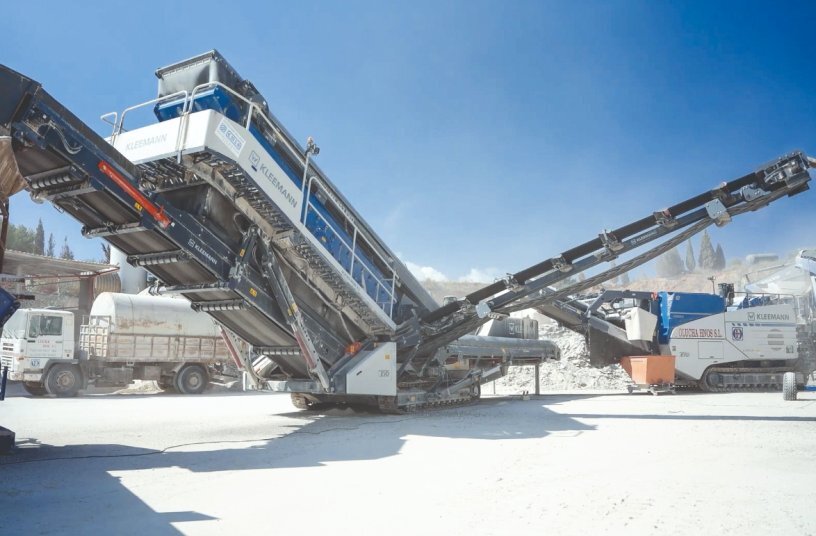
Olucha Hermanos in Valencia recycles ceramic tile rejects using Kleemann's MOBIREX MR 110 EVO2 impact crusher and MOBISCREEN MSC 953 EVO screen to produce fine material for new tile production.
-
The highly abrasive ceramic material challenges wear parts, but blow bars last about 140 operating hours, demonstrating strong durability.
-
An extended grinding path option on the crusher increased output by 25–30%, raising production to 120–125 tons per hour without additional fuel consumption.
-
The process achieves a 100% recycling rate, fully reintegrating rejects into the production cycle and exemplifying a successful circular economy model.
An impact crusher and a screening plant from Kleemann are helping to recycle ceramics in Valencia
Advertisement
Production rejects are being processed to produce a valuable resource: At a recycling company in Valencia in Spain, a MOBIREX MR 110 EVO2 impact crusher is being used to process ceramic tile rejects to produce a reusable resource. Even though the material is extremely abrasive, the process is efficient and impressively cost-effective.
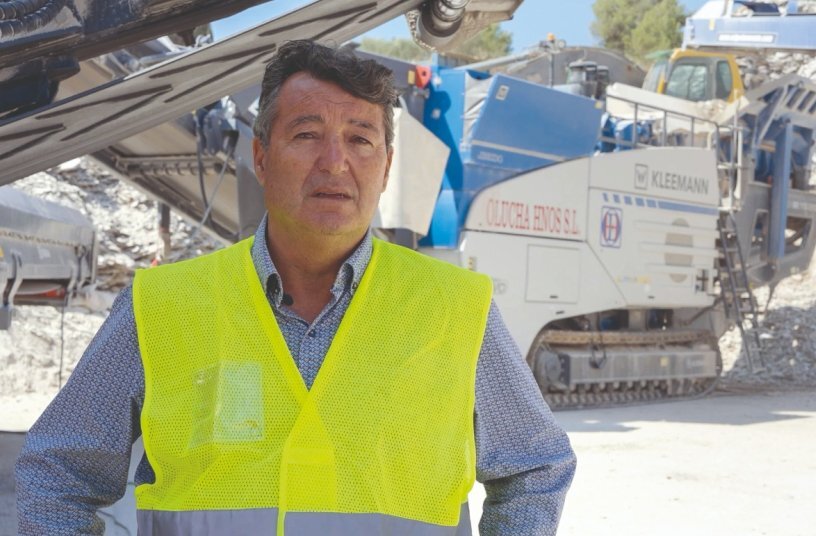
The family-run business Olucha Hermanos is turning rejects from Spanish tile factories into a valuable resource. With a history stretching back over 40 years, the company has developed a business model specialising in the recycling of rejects from the production of ceramic tiles. ‘In the past, this valuable material was simply dumped on landfill sites,’ explains Managing Director Ramón Olucha. ‘Today, we manage to return 100 percent of the material to the production cycle.’ The processed material is then used in the manufacturing of new tiles. Even the dust produced in the recycling process is reused. This is a perfect example of a circular economy in practice – even under such challenging conditions. At the heart of the process: A MOBIREX MR 110 EVO2 impact crusher and a MOBISCREEN MSC 953 EVO classifying screen.
The feed material consists of pure-grade ceramic tile rejects with grain sizes of up to 300 mm. The aim is the production of a final product with grain sizes of 0 to 6 mm, which is then mixed with clay and returned to the tile manufacturing process. In a closed cycle, the oversize aggregate is returned to the crusher via the post screen and the oversize return conveyor. This process is worthwhile: The rejects are bought in and can be sold on after processing for approximately 2 to 2.5 times the purchasing price per metric ton.
As abrasive as sandpaper
The challenging aspect of this application: The tile rejects consist of an extremely hard, sharp-edged ceramic material that acts like sandpaper on all wearing components. ‘Our blow bars stand up to this for around 140 operating hours. That’s outstanding output in this context,’ explains Ramón Olucha.
Close coordination with the Kleemann application technology team and the carefully considered plant configuration were decisive factors behind this smooth process. ‘We worked hand-in-hand with the Kleemann specialists to find the ideal equipment for the task. It was a long journey to get us to where we are today, but taking it was well worth the effort,’ reports the company CEO. The team initially experimented with cone crushers. But it was only when they switched to an impact crusher that they were able to achieve resounding success. Now it was time to fine-tune the system: Which blow bars would be up to the challenge? How could the post screen be aided by adding a supplementary screening plant? The current configuration with the downstream MOBISCREEN MSC 953 EVO classifying screen ensures that the final product precisely fulfils the specified requirements. This means that the processed ceramic rejects can be seamlessly integrated into the tile production process.
Individual option: An extended grinding path
The machine setting now also features an extended grinding path as an individual option. This increases the reduction ratio and thus produces as much fine material as possible. It was implemented on the MR 110 EVO2 for the first time in this configuration for the Valencian company and has proven to be extremely successful: Production has increased by 25–30 percent with the same costs – from the previous 90 metric tons to 120–125 metric tons per hour – without increased fuel consumption. ‘Thanks to this option, we have seen an enormous improvement in our output that completely exceeded our expectations,’ explains Ramón Olucha.
High-quality circular economy
With its innovative recycling approach, the Spanish company has not only created a strong commercial foothold, but it is also contributing to the establishment of a circular economy and the conservation of valuable resources. Its success is due in no small part to the close collaborative partnership with Kleemann and local sales partner EMSA. ‘The coordination, commissioning and support were perfect. The smooth workflow helps us overcome the challenges presented by the abrasive material and has enabled us to establish industrial recycling as a viable proposition here in the region. What used to be dumped as landfill is now fully reintroduced into the production process. That’s amazing!’ says Ramón Olucha enthusiastically.
Facts and figures
Machines
Impact crusher: MOBIREX MR 110 EVO2
Classifying screen: MOBISCREEN MSC 953 EVO
Final product
Grain size: 0–6 mm
Quality: Pure-grade
Recycling factor: 100%
Special features
Individual option: Grinding path
Feed material
Ceramic tiles: Production rejects
Grain size: 0–300 mm
Condition: Highly abrasive
Output/consumption
Output: 120–125 t/h with grinding path
Fuel: 30–35 litre/h
Gap setting
Setting: 0–5 mm
Source: WIRTGEN GROUP
Set LECTURA Press as your preferred source


