

9 August 2023, 08:37
-
The number of machines a contractor needs depends on various factors such as the business segment, the type of work, and the size of the project.
-
Contractors often have to balance the need for different types of machinery with considerations of transport and personnel costs, as well as time efficiency.
-
HYDREMA offers multi-purpose loaders that function as wheel loaders, mobile excavators, levelling machines, cranes, and rough-terrain forklifts, providing a versatile solution for contractors.
-
The company's machines are highly valued in Scandinavia and Germany for their versatility and efficiency in various applications, from building houses to road construction and forest maintenance.
-
HYDREMA also produces dumpers with off-road mobility, designed for soft soils, and prioritizes safety in their design.
-
The company took over the former Weimar plant in 1996 and has since focused on offering universal solutions to increase efficiency.
-
HYDREMA's City-Bagger and MX city excavator series are designed as universal working machines with powerful engines and pump performance.
-
The company's machines are characterized by their compactness, power, range, hydraulic performance, comfort, and safety.
-
The question of how many machines a contractor needs ultimately leads to considerations of fleet optimization and profit maximization.
This question is as simple as it is elementary for an entrepreneur and is very often paired with the topics "return on investment" or "efficiency on the construction site". Of course, the question is not easy to answer and depends on many other factors. For example, which business segment is served? A gardener and landscaper who works only or mainly in private gardens will be able to do without large machines and then rent them if necessary. But a contractor who carries out large public works, or who works in classic road construction, pipeline construction, sewer construction, civil engineering, etc., will ask himself this question again and again.
Advertisement
If we take a closer look at construction sites, we will see wheel loaders, mini excavators, telehandlers, wheeled excavators of various sizes and also tracked excavators. Very often we can observe that some machines stand around without being used on the construction site because, for example, they were used to move pallets, but other machines are used for excavation. We can also observe that very often smaller excavators are in use, but heavier and larger machines are on standby in the background because corresponding applications are not possible with the small excavator, or heavy components such as large pipes, etc. have to be moved.
The question then remains whether it makes sense to transport such an extensive machine park to the construction site, which has an impact on the level of transport costs. And not everyone can operate every machine equally well. You may then have to have different operating personnel on site, which influences the personnel costs. Changing the machine, from small to large or vice versa, influences the time efficiency and evenmore the fact of the effective use of the machine is an indicator for the often quoted "ROI", i.e. the return on investment".
This makes it clear that this simple question about the necessary number of available machines on the construction site is a very important business question that can also be quickly converted into a question about a sensible machine investment.
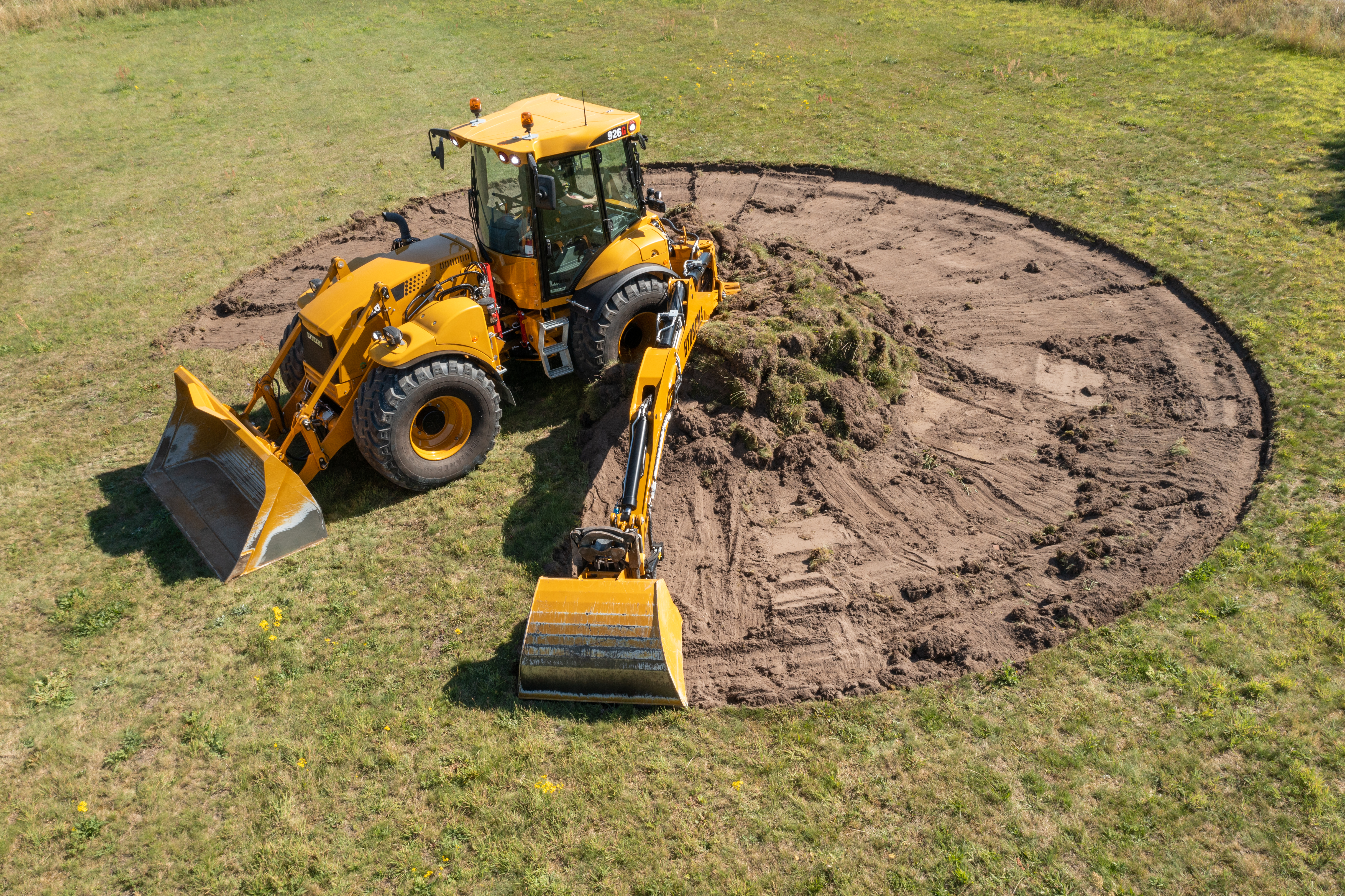
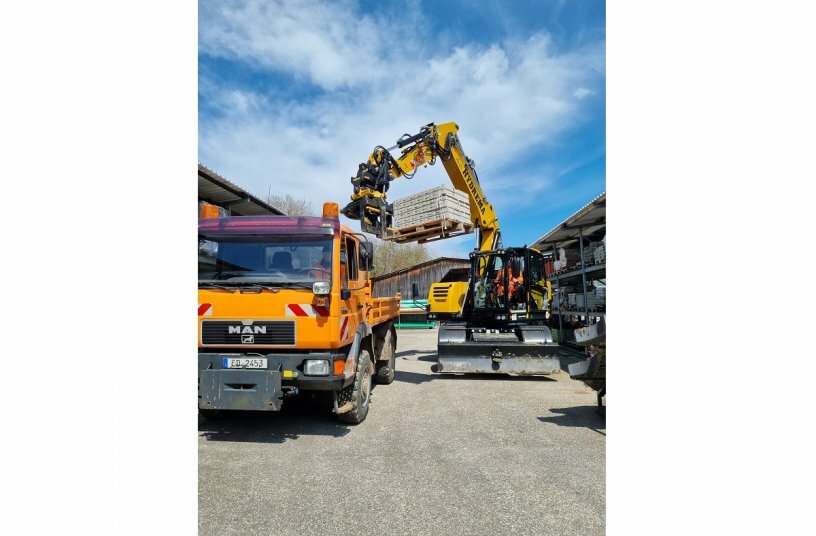
We at HYDREMA are trying to provide answers here. So the HYDREMA backhoe loader is not just a wheel loader with a rear excavator, which is a bit of a wheel loader at the front and a bit of an excavator at the back, but it is a full-fledged wheel loader and a full-fledged mobile excavator, at the same time even a leveling machine, crane and rough-terrain forklift. Because if the machine is already larger due to its design, then it should also correspond to a large 1.4 - 1.7 cbm wheel loader and a 10 ton mobile excavator and be correspondingly powerful in terms of transmission power. Our multi-purpose loaders have been highly valued in Scandinavia for decades due to their properties and also have their dedicated and growing fan community in Germany. Even if these customers have otherwise committed themselves to other brands, they keep buying our multi-purpose machine because it has become irreplaceable for their application. One uses the machine as a universal device for building houses, the other forestry company uses the machine in the forest, municipalities enjoy the versatility, whether in cemeteries, in road construction, or in forest maintenance. Others report on the internet that they have demolished entire houses with the machine and show the cleared area and still others enjoy the grader's capabilities with a grader attached to the front of the loader. It is also very impressive to see how the operator drives and steers the machine with a view on the excavator arm and how the machine is moved like a 10-ton mobile excavator on the construction site. In another moment, the machine drives with the pallet fork like an all-terrain forklift and moves a heavy component or a pallet with stones. With the tiltrotator, which is also equipped with a gripper, a heavy vibratory plate is brought to the right place of use on the construction site. In short, the proverbial Swiss army knife, i.e. the one machine for all cases.
The dumper, which was initially built as an 8-ton truck since 1983 and having a 10-ton payload since 1993 (today's 912), was then supplemented in production in 2003 by a 3-axle dumper with 20-ton payload (922). These machines are also real miracles of efficiency, because they have an off-road mobility that is urgently needed on the soft soils of the Danish coast, but also on all other soft soils in the world. Ground pressure measurements were carried out on a landfill in Teterow with the result that not even the usual tractor-trailer combinations were allowed to be used there, but only the 20-ton dumper from HYDREMA. In general, the dumpers from HYDREMA prove that they can always reach the crawler excavator out in the field, which then also ensures the efficiency of the crawler excavator. The new 707G dumper proves that safety is also important for HYDREMA. With this machine in the 7-ton class, the HYDREMA engineers have given the answer to the decision to ban officially conventionally built construction site tippers, where the operator has to look over the trough when driving. A large number of fatal accidents were registered due to the limited visibility and the high center of gravity and the associated low tilting moment of the machine type. All manufacturers tried to provide an answer and developed camera systems or rotating seats. However, HYDREMA decided to build the compact site dump truck like a large dump truck; with the driver's view of the track and the trough behind him and presented the solution at BAUMA 2019. At BAUMA 2022, many manufacturers joined this design.
When HYDREMA took over the former Weimar plant in 1996 and then built wheel loaders from 0.8 - 1.6 cbm, as well as chain excavators and wheeled excavators from 7 - 20 tons, HYDREMA dealt very intensively with the market and its own positioning as a manufacturer of machines. The conclusion is not just simply build machine technology, but also continue to offer the universal solution for the customer with this technology, in order to contribute to increasing efficiency. Based on the short-tail wheeled excavator presented in 1996, the City-Bagger was developed as an implement carrier concept that can be used as a universal working machine in conjunction with the tiltrotators that were becoming more widespread on the market at the same time.
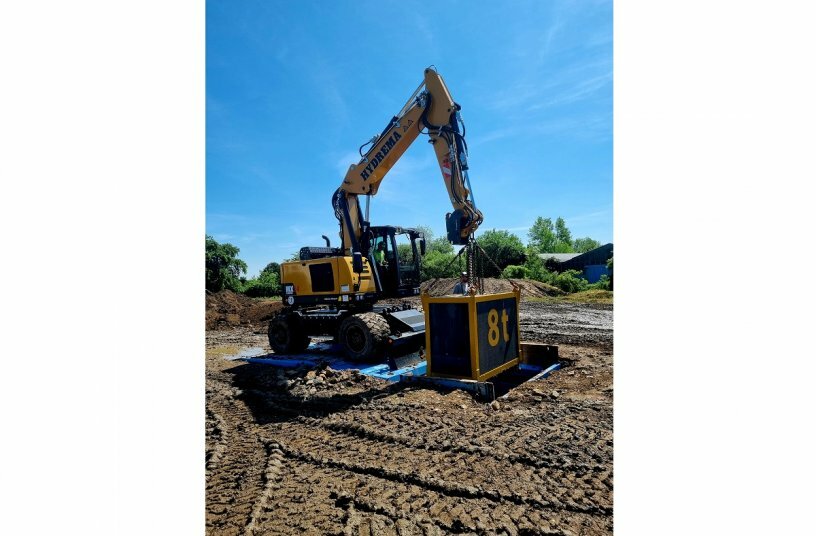
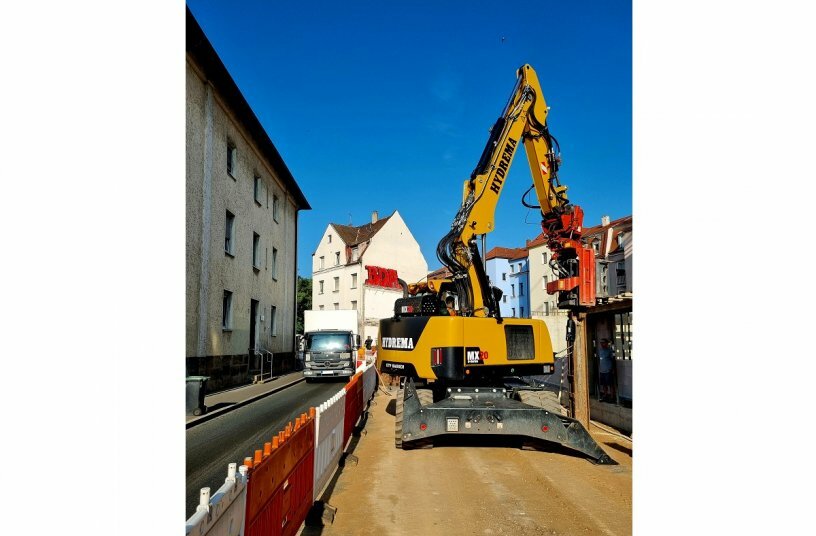
With the introduction of the MX city excavator series in 2013, the production of wheel loaders and crawler excavators was consequently ended and since then focused on the 3 machine divisions dumper, multi-purpose loader and city excavator. The city excavator is equipped with a powerful engine and an enormously powerful pump performance. With a total output of 407 liters, the machine offers enough power for many high-performance attachments. Whether mulchers, suction excavators, tree cutting machines or rams; the City-excavator from HYDREMA knows no challenges. With the lifting cylinders designed and manufactured by HYDREMA, which are very sensitively matched to the high-quality BOSCH-REXROTH pumps, the HYDREMA also has enormous lifting power and is considered the most powerful excavator in its class. And although the excavator has the most compact total swing radius, its cab is the largest on the market. There is no excavator that is as big and powerful as the HYDREMA. Since the machine also has an integrated tiltrotator control, the excavator not only replaces the wheel loader or telehandler when working with pallets, but can also set pallets down behind a hedge or a crash barrier, which neither wheel loaders nor telehandlers can do. It is compactness, power, range, hydraulic performance, comfort and safety that characterize this machine and thus make it an absolute all-round machine. With the MX14 we were already in an alley where a 5 ton midi excavator could hardly swivel, but it is no problem for the city excavator to lift an 8 ton element out of the pit, or a pallet of stones to lift over the garden fence. We call this the uncompromising work with a machine on the construction site. So if you consider the range of tasks that an MX City excavator can handle on a construction site, then we quickly come to the question of which machine investment makes sense and how many machines a contractor really needs. So we're talking about fleet optimization and thus about profit maximization for the company.
Source: Hydrema Baumaschinen GmbH
Set LECTURA Press as your preferred source

