


26 September 2025, 11:27
-
Vögele introduces InLine Pave and SprayJet, two paving technologies designed to improve efficiency and quality in asphalt road construction.
-
InLine Pave enables simultaneous paving of binder course and surface layer with high compaction, reducing material use and CO₂ emissions by eliminating the need for tack coats.
-
SprayJet technology allows thin layer paving hot over a spray seal in a single pass, increasing paving speed and reducing surface layer material by up to 50%.
-
Both methods support sustainable, resource-friendly construction while meeting strict environmental and quality standards.
InLine Pave and SprayJet from Vögele
Advertisement
Road construction contractors must meet increasingly stringent environmental and quality standards in asphalt paving, while remaining competitive. With InLine Pave and SprayJet, road paver specialist Vögele offers two methods that enable faster and more efficient realisation of paving projects with lower overall costs.
Globally proven technologies
Project completion deadlines in road construction are tight, especially when they involve the construction or rehabilitation of heavily frequented arterial roads. At the same time, contracting authorities demand the very best paving quality. Additional pressures arise from stricter environmental requirements and calls for resource-friendly construction methods – while construction contractors struggle with constantly rising material and labour costs. InLine Pave and SprayJet technologies are designed to address precisely these problems. Both paving methods are suitable for a wide range of applications and have a proven track record earned in years of successful use around the world.
InLine Pave: binder course and surface layer paving in a single pass
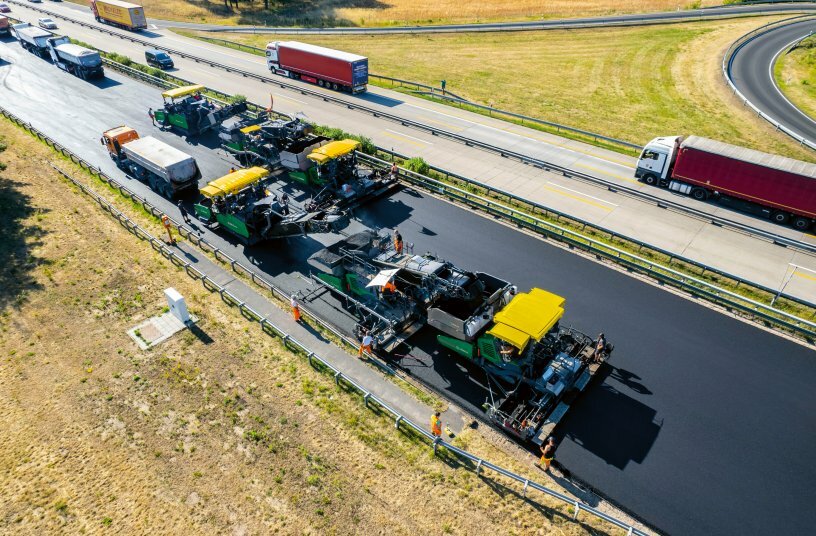
The InLine Pave concept is ideal for the construction and rehabilitation of motorways and highways - and wherever roads need to be reopened to traffic again as soon as possible. The name says it all: the machines work “in-line”, one behind the other, whereby the mobile feeder is loaded with the binder course or surface layer mix and transfers it to the SUPER 2100-3(i) IP binder course paver. With its AB 600 TP2 Plus high compaction screed, this machine is the key component of the paving train: During the paving process, the screed compacts the binder course to values of up to 98%, a level that is so high that the surface layer paver can follow on behind it without damaging the freshly-paved binder course. The paver for the binder course also features a special material transfer module that transports the surface layer material directly into the material hopper of the third machine in the train – a SUPER 1800 Dash 3 or Dash 5 generation paver – which then paves the surface layer.
Sustainable and high-quality asphalt pavement with lower emissions
‘Hot on hot’ paving offers a number of advantages: Optimal interlocking of the binder course and surface layer increases the quality and service lifetime of the surface layer. It also allows a reduction of the proportion of surface course to binder course material. On the one hand, this improves the stability of the pavement thanks to the higher proportion of stable binder course and prevents deformation. On the other hand, it reduces the amount of costly asphalt surface layer material required. What’s more, in contrast to conventional paving, there is also no need for spraying with bitumen emulsion as a tack coat – this also saves material and working time and reduces CO₂ emissions.

SprayJet technology for paving thin layers hot over a spray seal
If the renewal of a surface layer is required, paving thin layers hot over a spray seal is a cost-optimised, efficient and resource-friendly technology. With the SUPER 1800-3(i) SprayJet, Vögele offers a special spray paver that has a proven track record on projects around the world. It sprays bitumen emulsion onto the old pavement and paves the new surface layer over it in a single pass.
The five spray bars with a total of 24 nozzles enable seamless application of the bitumen emulsion over varying paving widths of up to 6 m and, as the SprayJet module is a self-contained functional unit, it also allows the use of the SUPER 1800-3(i) SprayJet in the role of a classic road paver. The module is easy to maintain and is logically integrated in the Vögele ErgoPlus 3 operating concept.
Higher paving speed and quality
SprayJet technology is particularly efficient and is, in principle, suitable for all paved surfaces used by traffic. The paving speed is often much higher than with conventional paving methods and, as the layer thickness is generally 2.0 cm rather than the usual 4 cm, this also means potential savings of up to 50% of the surface layer material otherwise required. The use of the SprayJet method also brings numerous benefits with regard to quality. As spraying the emulsion and paving the surface layer take place in a single pass, the binding agent film cannot be driven over inadvertently and damaged by other construction vehicles. The binding agent film seals the entire lower layer and provides an effective barrier against water. This further increases the service lifetime of the road.

Two methods for all paving requirements
Whether for rehabilitation, construction from new, or inner-city construction projects: With In-Line Pave and SprayJet, Vögele offers two technologies that take both the challenges faced by road construction contractors and their clients’ specific requirements into account: faster, more efficient and more sustainable road construction or rehabilitation, the use of less material and conservation of resources and the realisation of high-quality asphalt pavement surfaces.
Source: WIRTGEN GROUP
Set LECTURA Press as your preferred source


