

14 October 2026, 14:51
-
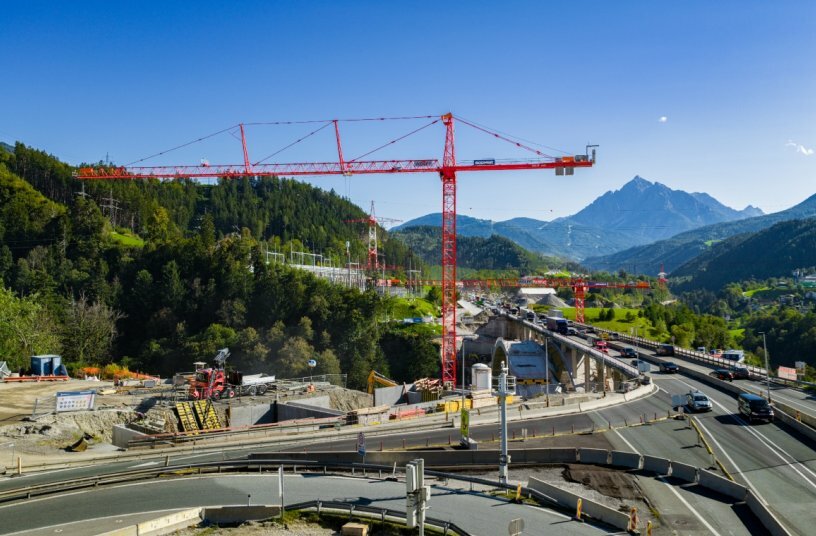
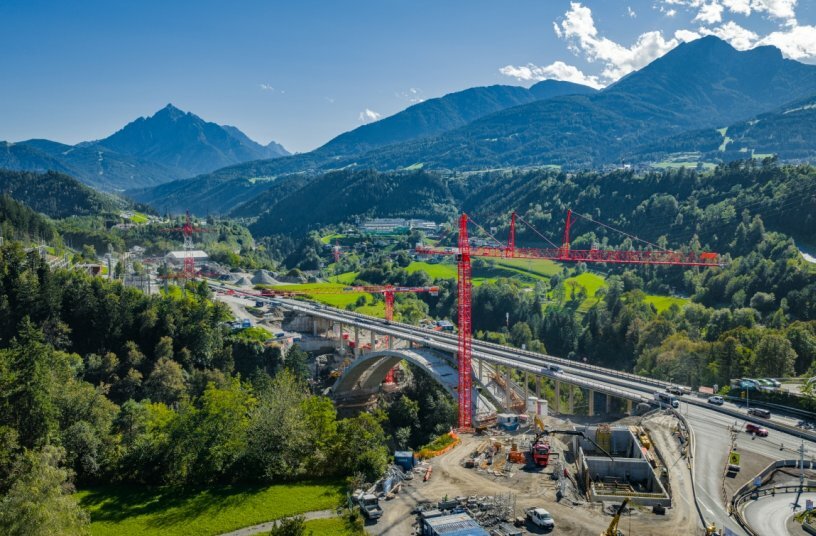
Two new WOLFF trolley jib cranes with 80m and 70m jibs were installed on opposite sides of the Sill Gorge for the demolition and reconstruction of the Sill Bridge on the A13 Motorway.
-
The challenging gorge environment required complex assembly logistics, including the use of a 450-ton mobile crane and foundation anchors placed deep in steep slopes.
-
The cranes, with lifting capacities of 25 and 20 tons, will handle materials and equipment over a three-year construction period while maintaining traffic flow.
-
Environmental constraints such as high-voltage lines and proximity to Innsbruck Airport necessitated special permits and safety measures including aviation obstruction lights.
-
This project marks the first use of WOLFF trolley jib cranes by the BODNER Group, who valued both the cranes' capabilities and Wolffkran's comprehensive planning and support.
On the A13 Motorway south of Innsbruck, the new Sill Bridge is currently being built over the Sill Gorge on behalf of ASFINAG. It will replace the old structure dating back to the early 1960s. The new construction is taking place while keeping traffic flowing, placing high demands on logistics and execution planning. For the demolition of the existing bridge and subsequent new construction, the executing Kufstein-based BODNER Group purchased two new WOLFF cranes – the first WOLFF trolley jib cranes in their fleet.
Advertisement
The two cranes – a WOLFF 8060.25 Cross with an 80-meter jib and a WOLFF 8038.20 Clear with a 70-meter jib – were positioned on opposite sides of the Sill Gorge and mounted into the slope of the gorge in the summer of 2025.
Even assembling the cranes presented logistical challenges for the team. Due to cramped conditions in the gorge, the jib of the WOLFF 8038.20 Clear was installed in two sections using two different mobile crane locations. For the assembly of the larger WOLFF 8060.25, a 450-ton mobile crane was brought in. Installing the foundation anchors was also complex, as they are located 14 meters into the steep slope and approximately 20 meters below the bridge abutment. As a consequence, the Wolffkran team did more than just deliver cranes; they were closely involved in planning right from the start.
From their positions on the gorge walls, the WOLFF cranes cover all working zones for both the demolition and reconstruction of the bridge. Over the roughly three-year construction period, with lifting capacities of 25 and 20 tons, they will be responsible for transporting formwork elements, concrete, machinery, and other job-site equipment.
Complex Environment, Precise Planning
It was not only the location at the gorge that brought unique challenges, but also the surrounding environment. High-voltage power lines run above the construction area, while at the same time, the safety zone of Innsbruck Airport extends right up the project site. Appropriate permits had to be obtained to operate the cranes, and both units were equipped with aviation obstruction lights.
Furthermore, the steep slopes of the Sill Gorge severely limit the available staging area for equipment and job-site facilities.
“Projects like the Sill Bridge show that infrastructure construction is about more than just lifting capacity. What really matters is a carefully coordinated approach to crane selection, positioning, and assembly,” says Dominik Zielinski, Sales Manager for Austria at Wolffkran.
A WOLFF Debut for Bodner
The BODNER Group is deploying WOLFF trolley jib cranes for the very first time on this project. “Naturally, the crane’s high lifting capacities were an important criterion for us. Equally important, however, was the support provided by the Wolffkran team, from planning to assembly” says Jürgen Peer, Technical Manager at BODNER. “On projects of this scale in particular, we value experience, know-how, and direct points of contact at all times.”
As part of the Brenner Motorway (A13), the Sill Bridge is one of the most critical transit links between Austria and Italy. The existing bridge will be replaced in several construction phases. First, the bridge structure carrying traffic toward Innsbruck will be demolished and rebuilt, followed by the structure carrying traffic toward the Brenner Pass. Traffic on the Brenner Motorway will be maintained throughout the entire construction period. Completion of the new bridge is scheduled for late 2028.
Source: WOLFFKRAN International AG
Set LECTURA Press as your preferred source