

3 August 2023, 10:29
-
Kassel, Germany is replacing two aging stormwater overflow basins with larger ones at the sewage treatment plant
-
Contractor Schnittger chose to use technology from KEMROC for the demolition of the concrete rims of the basins
-
Last year, a DMW 130 cutter wheel was used for the first basin, and this summer, a larger DMW 220 cutter wheel was used for the second basin to complete the work faster
-
Kasselwasser, a municipal company, is responsible for drinking water and wastewater disposal in Kassel
-
Wastewater flows through a network of sewers to the sewage treatment plant, where it is clarified and purified before being returned to the natural water system
-
The stormwater overflow basins are used as temporary storage for coarser solids deposited in them
-
The two original basins, built in 1978, were no longer state-of-the-art and unable to handle heavy rainfall events
-
Kasselwasser decided to build two larger basins, each with a capacity of 6,000 m³, at a cost of around 12.5 million euros
-
The demolition work was awarded to local construction company Schnittger as a subcontractor
-
The concrete walls of the basins were up to 2.50 m thick, posing a serious challenge for demolition
-
Schnittger used KEMROC cutter wheels to break up the concrete rims, as other methods were not feasible
-
The demolition process involved making cuts through the concrete rim and breaking the segments using a shearer attachment
-
The DMW 220 cutter wheel played a crucial role in the demolition work, allowing for minimal vibration and efficient cutting
-
The smooth cutting action of the wheel resulted in less noise and vibration for the excavator operator
-
The demolition work on the second basin took four weeks and produced 2,000 m³ of broken concrete
-
Schnittger believes that milling attachments like the KEMROC cutter wheel will be important in future demolition projects.
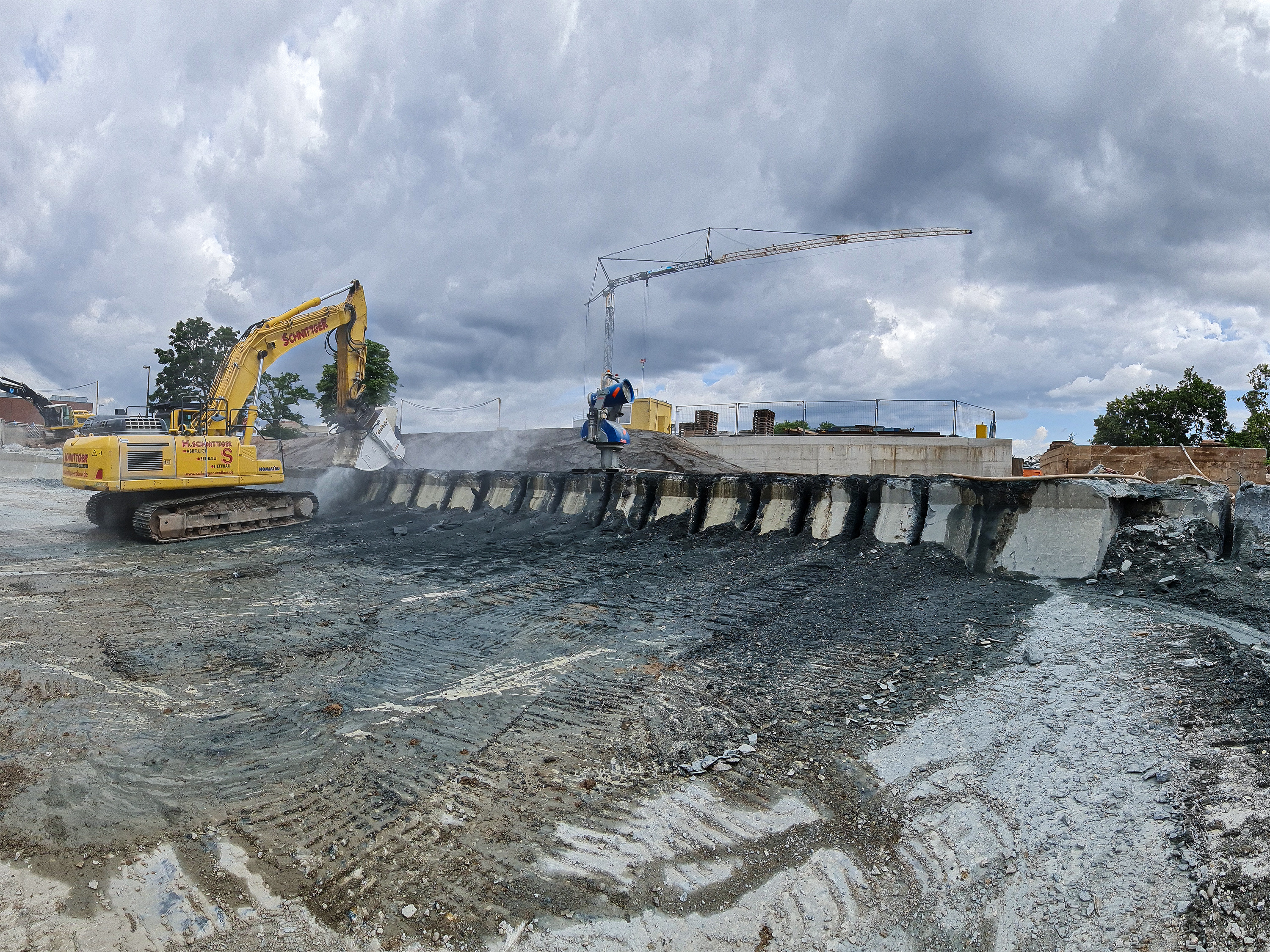
Demolition using an excavator with a DMW 220 cutter wheel
Rainwater overflow basins in Kassel to be replaced
Advertisement
The city of Kassel in the German state of Hesse is gearing up for the future. At the sewage treatment plant, two aging stormwater overflow basins are being replaced by larger ones. To demolish the massive, ring-shaped concrete rims of the basins, the contractor Schnittger decided to use technology from KEMROC. Last year, a DMW 130 cutter wheel was used to demolish the rim of the first basin. This summer, a larger DMW 220 cutter wheel was used on the second basin to complete the work faster.
Kasselwasser – this is the name of a municipal company with more than 170 employees providing drinking water and wastewater disposal in Kassel since 2012. Wastewater flows through a network of approximately 840 km of sewers to the sewage treatment plant, where it is clarified and purified and then returned to the natural water system via the Fulda river. Wastewater collected from private households, commercial and industrial sites, and public buildings, as well as rainwater from Kassel's roofs and streets eventually reaches the sewage treatment plant. The initial surge of water from the storm sewers flows into two rainwater overflow basins where solids are deposited. These basins can be full after 5 to 10 minutes when it rains really heavily. The basins are used as temporary storage for the coarser solids that have been deposited in them. After having flowed through the overflow basins, the storm water is significantly cleaner and filtered. After flowing through the two stormwater overflow basins, the significantly cleaner and highly diluted dirty water runs into the Fulda. The stormwater is cleaned by precipitation in such a way that it has a similar (or even better) quality than water that normally passes through and is cleaned by the sewage treatment plant. However, because the two original open basins (built in 1978) with a capacity of 4,250 m³ were no longer state-of-the-art and heavy rainfall events have been occurring more frequently, Kasselwasser decided to build two larger basins, each with a capacity of 6,000 m³.
The project, which costs around 12.5 million euros, stipulates that during the construction period, expected to take two years, a stormwater overflow basin will always be available. For this reason, the plan was to replace one basin with a new one and then to replace the second basin with a new one. The contract for the demolition of the basins was awarded to the local construction company Schnittger as a subcontractor of the Laudemann company. The demolition work was a serious challenge: with a pool height of 4 m and an outer diameter of 46 m, the concrete walls were up to 2.50 m thick.
Alternating between cutting and breaking loose
Heinz Schnittger GmbH started in 1960 as a small haulage company with one truck and a lot of commitment. Over the years, other business sectors have been added to the original freight business. Today, with 60 employees, Schnittger GmbH is considered as one of the most renowned medium-sized civil engineering and freight companies in Northern Hesse. As part of its diversification, demolition contracting became one of its core business areas. This division of Schnittger was responsible for the demolition of the two stormwater overflow basins in the Kassel sewage treatment plant. Managing Director Dennis Schnittger had previous experience with milling attachments from KEMROC. Since the use of excavators with hammers was not possible because of the noise and other methods proved to be uneconomical, it was decided to use cutter wheels to break up the mighty concrete rim of the basins.
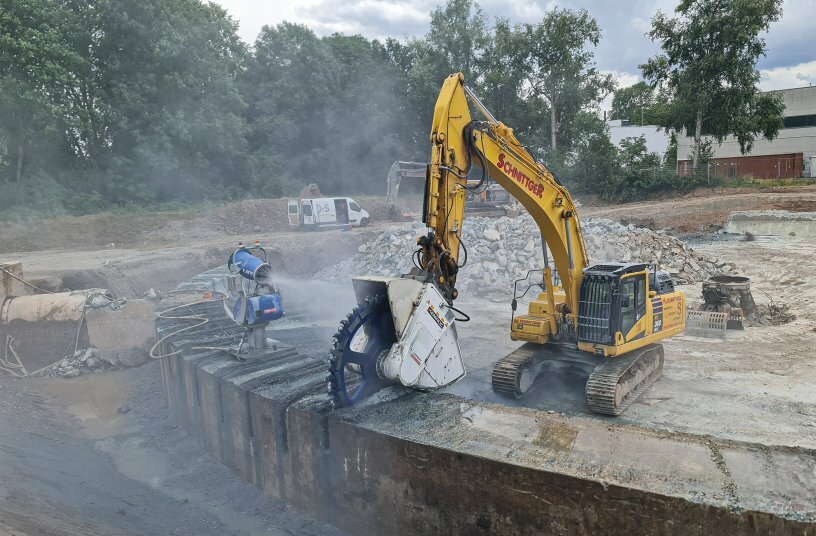
After successful demolition of the first basin using a KEMROC DMW 130 cutter wheel on a 40-tonne excavator in spring 2022, an even more powerful DMW 220 cutter wheel was rented this summer for use on the company's own 40-tonne excavator.
The demolition process involved the following steps: the excavator drives over a heaped ramp into the basin, positions itself in the centre and makes a series of cuts through the concrete rim about 1 m apart, first from above, then from the sides almost to the ground, creating individual segments. After that, another 40-tonne excavator goes to work and breaks these segments up using a shearer attachment. The broken concrete is then transported away for processing in a recycling plant.
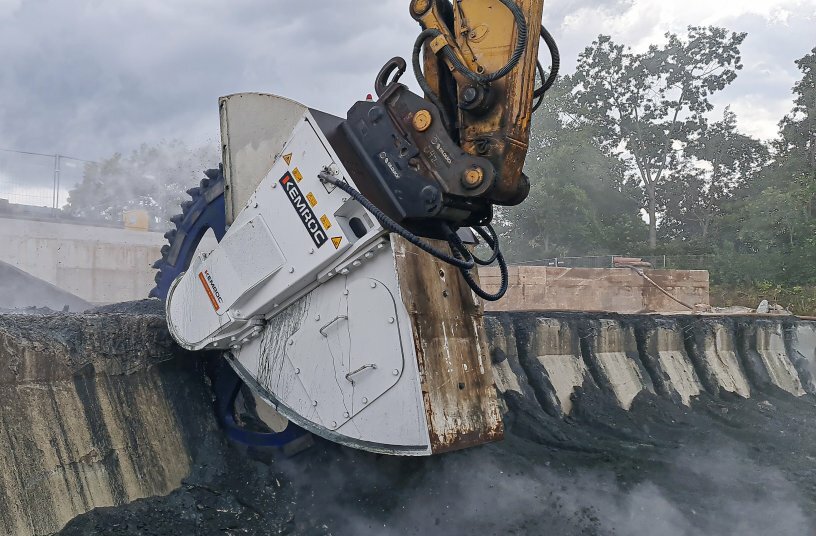
The demolition work on the rim of the second basin took only four weeks in June and July 2023. Both basins produced 2,000 m³ of broken concrete. For the contractor Schnittger, the cutter wheel played a very important role in the demolition work: According to the terms of the contract specified by Kasselwasser, the work had to be carried out with minimal vibration using milling, sawing, cutting or shearing technology. Pre-cutting the concrete rim with the KEMROC cutter wheel into smaller, manageable segments turned out to be critical according to the company MD, Dennis Schnittger: "Cutting through the rim de-stressed the concrete making the subsequent work with the shearer attachments faster and more effective than would otherwise have been the case. The smooth cutting action of the wheel also resulted in much less disturbing noise and annoying vibration for the excavator operator. From our point of view, we can see that these milling attachments will play an important role in demolition projects in the future."
Source: KEMROC Spezialmaschinen GmbH
Set LECTURA Press as your preferred source
