

25 September 2023, 16:10
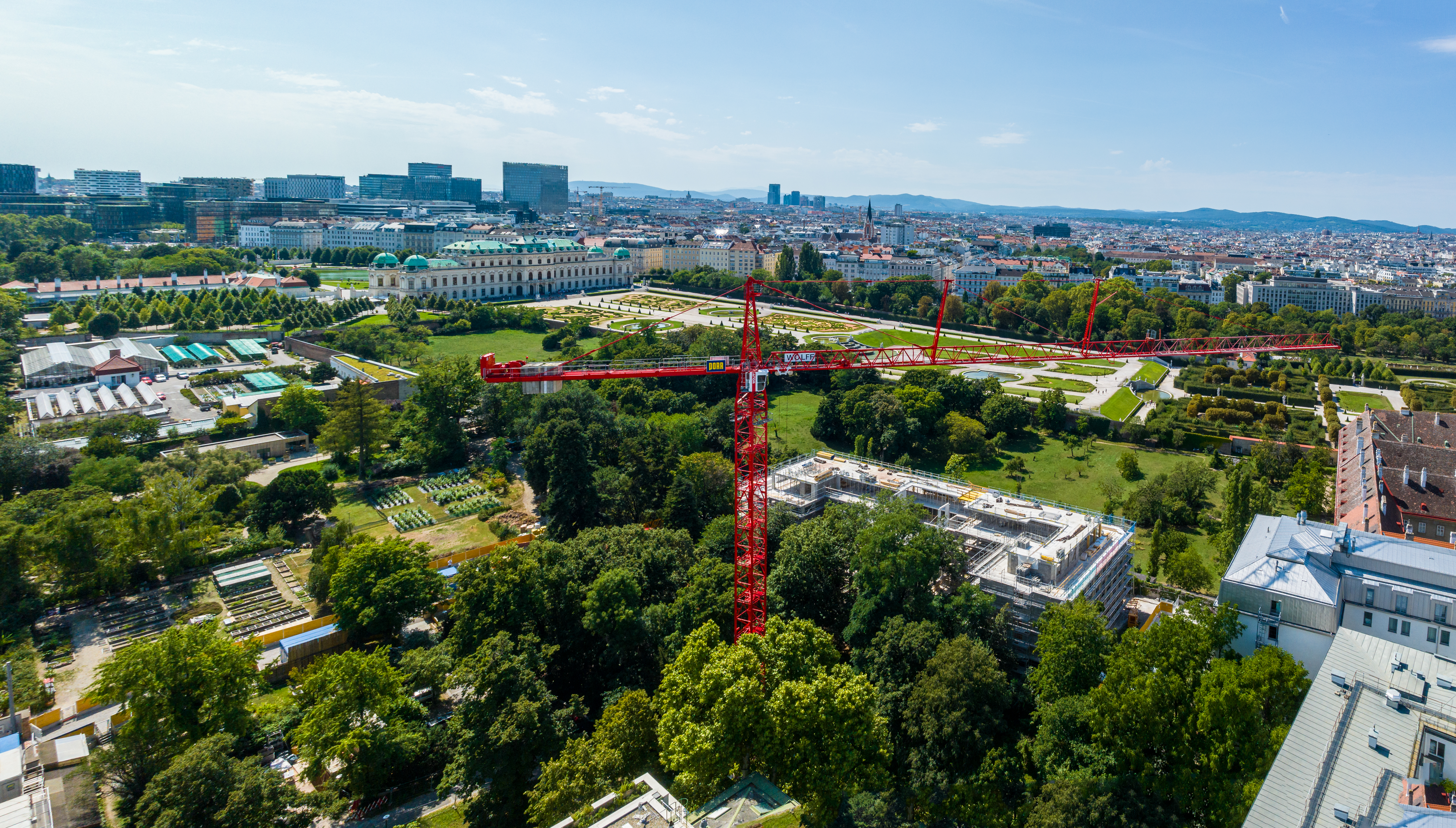
Austria’s most powerful construction crane is currently at the center of Vienna – not far from the Bel- vedere Palace. The WOLFF 8060.25 Cross is restructuring the European Patent Office building on Rennweg on behalf of con- struction company PORR. Planned by the firm ATP architekten ingenieure, this restructuring operation will be carried out ac- cording to the latest environmental standards, and assembling and operating the red giant will even play a significant role in protecting the surrounding flora and fauna.
The only possible location for the crane in Vienna’s densely popu- lated and high-traffic Landstraße district was the botanical garden at the University of Natural Resources and Life Sciences in Vienna be- tween old and listed trees. The architects and construction site team worked closely with Vienna’s Wolffkran team and managed to find an environmentally friendly assembly concept and a suitable location for the crane. Only a small tree and a hedge stood in the way of the WOLFF crane, but they were successfully replanted elsewhere.


A sophisticated assembly requires precise planning
Since a mobile crane is unable to drive into the botanical garden, the WOLFF 8060.25 Cross was assembled from a distance of approx. 50 meters from the surrounding Prätoriusgasse using a 450 t mobile crane with top. “To make this complex operation a success, it not only took the expertise of our experienced assembly team but also close coordination and planning with the transport company since hardly any storage space is available on-site for the crane compo- nents,” says Zeljko Tenjovic, Managing Director of Wolffkran Austria GmbH.
The crane was assembled at the beginning of January. Prätori- usgasse – one of the main roads in the construction site area – had to be closed for the assembly, which is why the work had to be done within the narrow time frame of the school holidays, when traffic is low. Despite poor weather and shorter daylight hours, the crane was set up in just four days. The dismantling will likewise occur in the same fashion during the holidays next January.

A high lifting capacity makes soil-friendly transport possible without construction vehicles
To overcome the distance between its location and the patent office building, the WOLFF 8060.25 Cross was set up with a maximum jib length of 80 meters. Despite its long jib, it still lifts a considerable 7.0 tons. “Its performance is unique in this crane class, making the WOLFF 8060.25 Cross currently the most powerful construction crane in Austria,” says Zeljko Tenjovic.
The WOLFF 8060.25 Cross is able to fully take advantage of its high point-bearing capacity to reconstruct the European Patent Office. Since the objective is to use the construction road through the bo- tanical garden as little as possible for environmental protection rea- sons, the crane transports both tipper bodies with rubble and any construction materials, construction equipment, and heavy prefabri- cated parts – such as entire staircases – back and forth between Prätoriusgasse and the construction site.
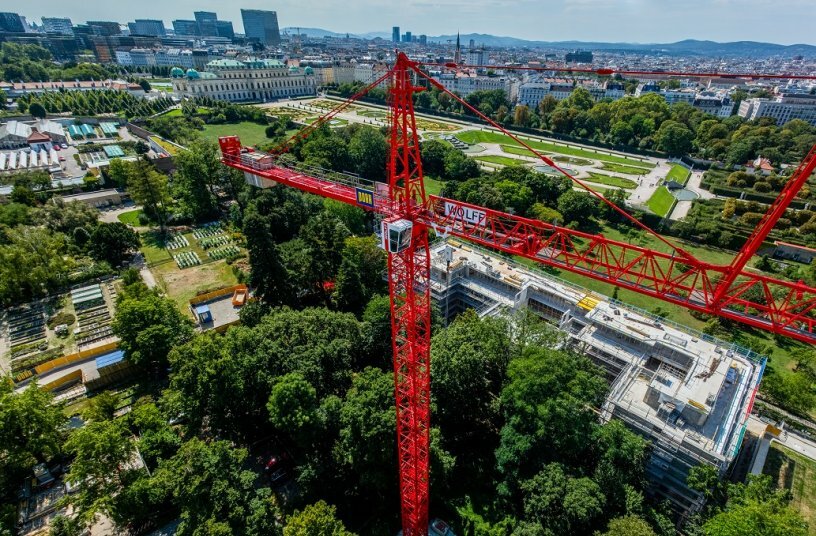
The European Patent Office’s 50-year-old building will be fully gutted and restructured in a climate positive manner with heat recovery sys- tems, a photovoltaic system on the roof, and the use of many sus- tainable wooden elements. As a result, it is expected to produce more energy than it consumes when it is commissioned at the end of 2024.
Source: WOLFFKRAN GmbH
Set LECTURA Press as your preferred source