

17 April 2023, 14:45
Concrete demolition with KEMROC milling attachments
Advertisement
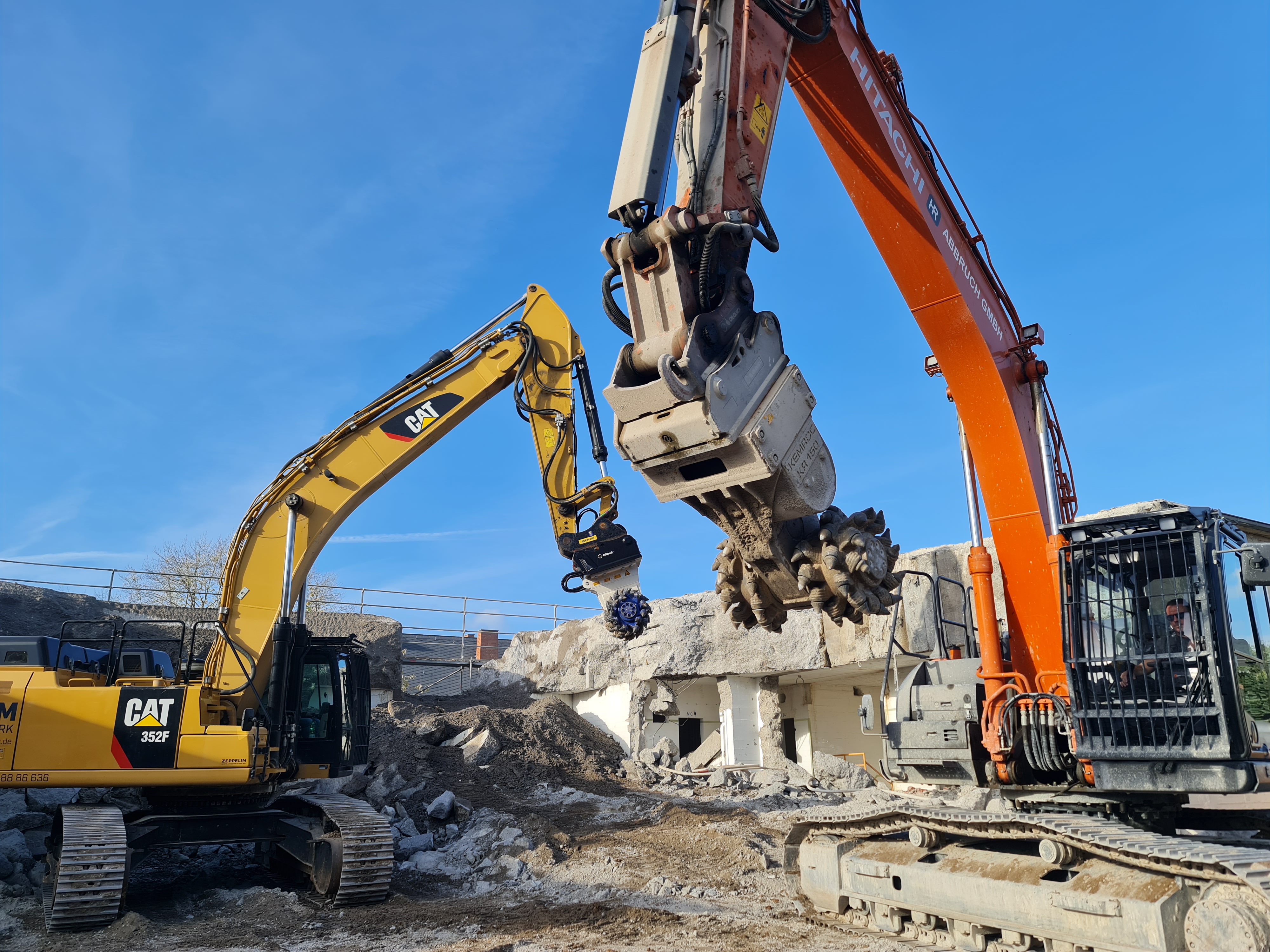
In the German city of Koblenz, a high-rise World War II bunker is given a new lease of life. The mighty building made of solid concrete is to be transformed into a high-quality residential complex. To start this transformation, contractor HR Abbruch had to make some structural changes to the building. Milling technology from the manufacturer KEMROC played a key role in the initial phases of this project. A large excavator with milling attachment completed demolition work with low noise and low vibration levels while in close proximity to neighbouring residential buildings.
With remarkable dimensions of 40 m length, 16 m width and currently 10 m height, an old high-rise bunker in Koblenz (Germany) forms a striking landmark from days gone by. Built during the Second World War in the central district of Oberwerth, it once offered protection to almost 1,000 people. Now it is going to be transformed. The mighty building is being converted into a residential complex. This involves removal of the roof and one side of the building. Three outer walls will remain and window openings will be cut into them at a later stage using wire saws.
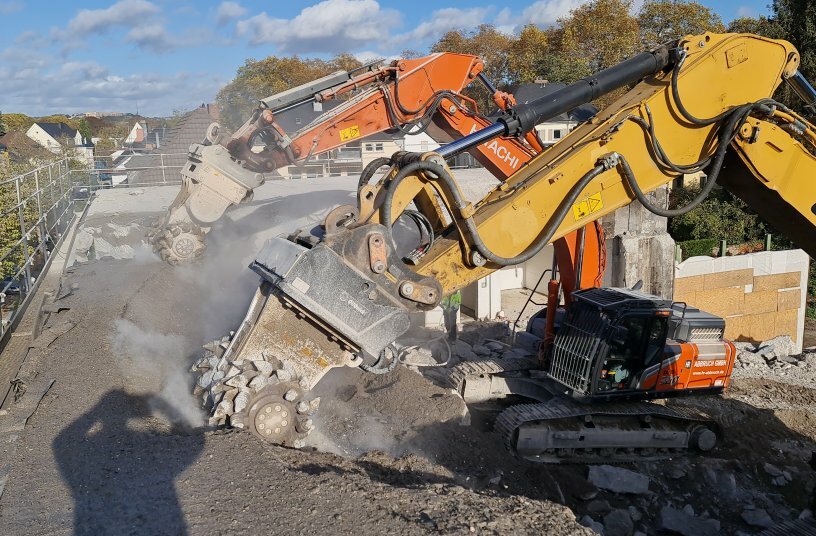
The contract for this extensive preparatory work was secured by demolition, gutting and disposal specialists, HR Abbruch GmbH, a company from Neuwied in Rhineland-Palatinate. However, in the densely built-up Koblenz district of Oberwerth, there is no space for a crane to knock large concrete sections out of the massive building for transportation. Therefore, the demolition team led by site manager Sebastian Sommer decided to find an alternative method for the partial demolition of the building. "Of course, we couldn't use explosives in the middle of the city," commented the graduate engineer, "and in the immediate vicinity of the surrounding residential buildings, the use of hydraulic excavators with demolition hammers was not an option. In addition, the building is constructed with completely unreinforced concrete, which could be weakened structurally if hammers were used. The only remaining option for us was to use milling technology."
Technical solution – grinder attachments
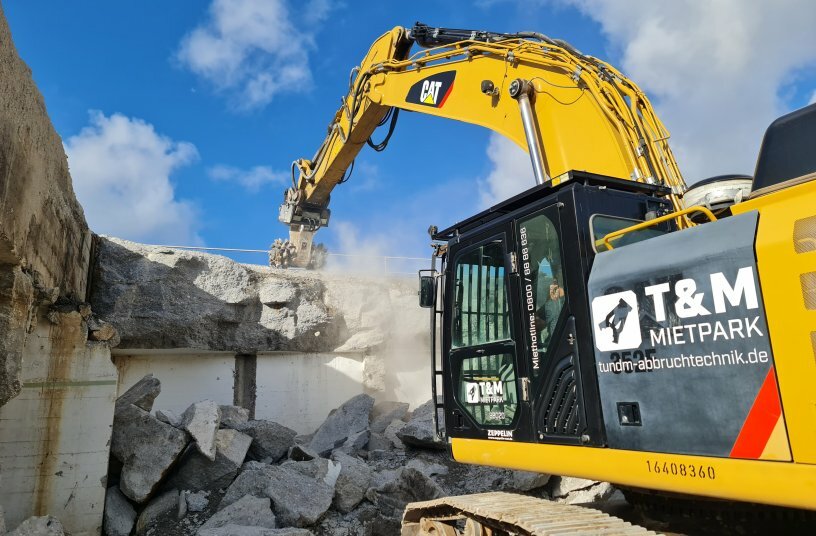
In October 2022, construction equipment supplier T + M Abbruchtechnik GmbH initially rented a KR 150 (120 kW) drum cutter attachment from the manufacturer KEMROC and mounted it on a company-owned 35-t excavator. After several weeks of continuous use, this combination proved itself to be from a technical standpoint, a viable solution. For higher productivity however, a more powerful excavator-milling combination was required. This was discussed with Thomas Micheel, the managing director of T + M Abbruchtechnik based in Kruft near Koblenz, whose company specializes in the sale, rental and repair of demolition equipment. The conclusion was to use a 50-t excavator from T + M’s rental fleet together with a KEMROC KRD 165 (160 kW) rotary drum cutter attachment. This equipment was used to create the openings in the outer walls and to demolish the roof of the building so that wire saws could be used at the later stages to remove other sections including the creation of window openings to within tight tolerances of the required dimensions.
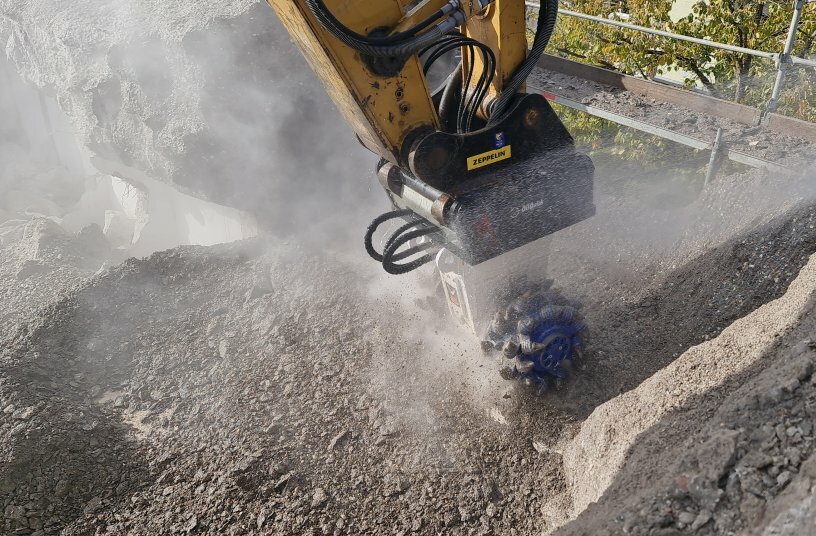
The KRD range of rotary drum cutters manufactured by KEMROC are available for excavators from 0.5 t to 50 t operating weight. With their robust and compact design, they offer a high performance to weight ratio. The direct drive converts the hydraulic power from the excavator to cutting forces with exceptionally low losses. The KRD 165 used by HR Abbruch in Koblenz-Oberwerth is the largest model in this range and is suitable for carriers from 35 to 50 t.

At the beginning of February 2023, the milling work in Koblenz was completed and the excavator and attachment combination rented from T + M Abbruchtechnik was withdrawn from the construction site. "With an exterior wall thickness of around 2 m, creating openings into the bunker building is not an easy task for any machine configuration," commented Sebastian Sommer on the successful completion of the work, "but under the given circumstances, renting this equipment was technically and financially the best solution for this job." In terms of productivity and fuel consumption, according to the site manager, grinding the unreinforced concrete was comparable with the use of hydraulic demolition hammers. In addition, the contractor noted that the higher contact pressure, resulting from the heavier excavator-milling combination and a low working height, increased productivity. Vibration which could be harmful to man, machine and the environment was also lower when maintaining a higher level of contact pressure. "Constant vibration monitoring carried out during our milling operation registered only one result that required a short interruption of our work," says the graduate engineer. "Excavator-mounted milling attachments will certainly become increasingly important in inner-city demolition projects and will largely replace classic hydraulic hammers."
Source: KEMROC Spezialmaschinen GmbH
Set LECTURA Press as your preferred source
