

17 March 2025, 06:35
-
igus is developing PTFE-free plastics for moving applications due to potential PFAS bans and sustainability concerns.
-
The company offers a wide range of PTFE-free products, including plain bearings, gears, linear guides, and energy chains.
-
igus has an in-house compounding facility and extensive test laboratories to develop and test new material formulations.
-
The new PTFE-free materials, such as iglidur J PF, show significantly better performance in friction and wear tests compared to their PTFE-containing counterparts.
-
Over 75% of igus products sold are now PTFE-free, with further developments and new products to be presented at Hannover Messe in March 2025.
Best practice: research and use of PTFE-free plastics for moving applications
Advertisement
Polytetrafluoroethylene (PTFE) has been the hero in the fight against friction and wear for years. However, there is also the other side of the coin: as a persistent material, PTFE is currently the focus of the discussion about a possible PFAS ban by the ECHA. Even if there is no ban, the motion plastics pioneer igus from Cologne has good reasons to look for alternative materials. With new formulations, extensive tests and adapted production processes, igus already offers its customers a wide range of PTFE-free products made from its own materials.
The Cologne-based company igus manufactures industrial components made of high-performance plastic, ranging from small plain bearings and gears to linear guides and energy chains weighing several hundred kilogrammes. Perfluorinated and polyfluorinated alkyl substances (PFAS), among other things, make some of these plastics exceptionally robust and resistant to wear, weather, chemicals and extreme temperatures. The fluoropolymer PTFE, which is part of the PFAS group, also ensures low-friction dry operation, making the use of lubricants superfluous.
Early decision by the management
The outstanding specifications of these compounds also cause problems: their high chemical stability means that PFAS substances accumulate in living organisms and ecosystems as they only decompose very slowly. The European Chemicals Agency (ECHA) is therefore considering a possible ban on these substances. Until the political committees make a decision, it remains unclear which substances could be prohibited. Irrespective of the political decisions, there are good reasons from a sustainability perspective to start working on alternatives now. For companies such as igus, which have previously relied on PTFE in their materials, there are not only challenges but also economic opportunities. This motivated the management of igus to offer PFAS- and PTFE-free product alternatives to the proven igus plastics and invest further in product development. The response from igus customers has been great: many companies decided at an early stage not to wait for a possible ban, but to opt for PFAS-free materials when developing new products.

Laboratory compounding and test specimen production
igus has a very high vertical range of manufacture and its own development department for materials. What's more, there is an in-house compounding facility, a technical centre for procedural tests and test specimen production as well as extensive test laboratories for materials and products. Thanks to close collaboration with a wide network of raw-material suppliers, distributors, additive specialists and compounders, material developers at igus can obtain a comprehensive overview of the market situation.
The first step in material development is to examine possible alternatives to PTFE that are no more expensive and do not contain any problematic ingredients that could be affected by a ban in the future. igus carries out tests with various base polymers and promising additives. The ability to test new ideas immediately on a laboratory compounder is particularly helpful for material development.
It allows for the realisation of innovative market-driven technical solutions while using resources as sparingly as possible. With the help of twin-screw extruders and customisable screw configurations, sample quantities can be produced in a short time. Fibres, granulates and powdered additives can be processed into compounds in different proportions.
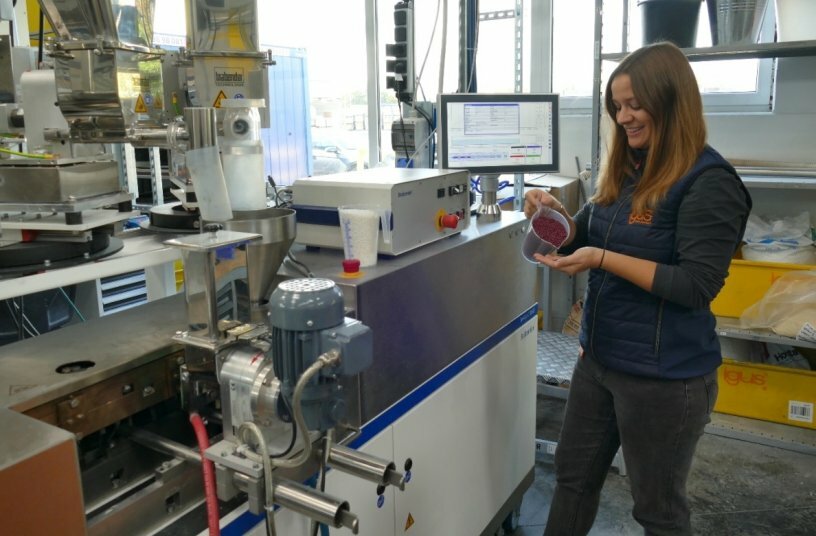
igus sets great store by offering its customers comprehensive advice and the right products. The company therefore carries out numerous tests on real products. Permissible surface pressures, thermal specifications, areas of application and ambient conditions are tested and defined. For internal toolmaking, igus determines data on material shrinkage so as to manufacture customised products. This is particularly important when switching to PTFE-free materials. Modifying the material composition can also change the processing characteristics and the tendency to shrink and warp. igus ensures that the new materials can be processed in the existing tools so that customers do not have to buy new tools. With this careful approach, igus customers always receive the best and most innovative solutions.
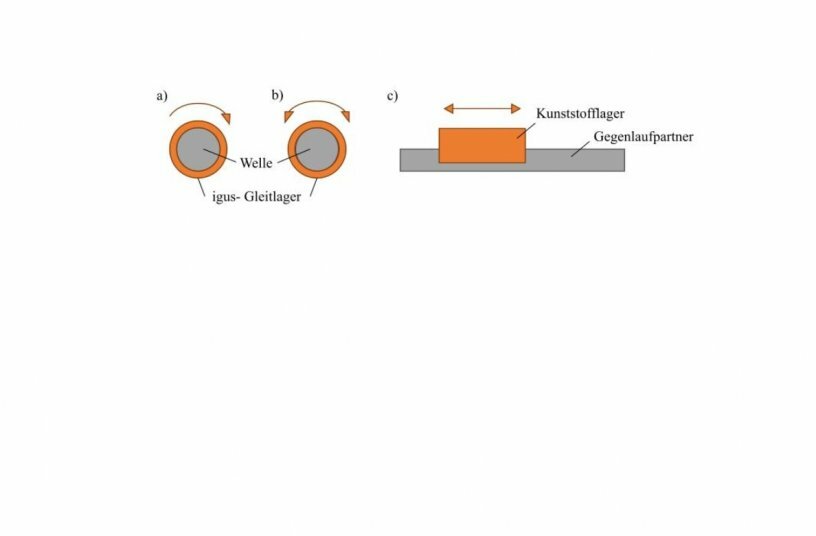
After compounding the developed formulations, the materials are processed into test specimens via injection moulding. A large number of test specimens are used. For tribology and wear tests, igus produces test specimens consisting of pin and disc that are tested on tribometers. As igus products are mainly used for lubrication-free bearings and the low-wear movement of machine elements, the primary focus of the test is on the specimens' wear and friction behaviour. In these tests, the test specimens are brought into moving contact with counterparts that are important for mechanical and plant engineering under various conditions. These can be shafts made of hard-anodised aluminium, 304 SS stainless steel or Cf53 precision shaft steel, for example. However, customised tests with other materials are also possible. The contact pressure and relative speed are varied according to previously defined conditions. In addition, igus tests various types of movement. These can be, for example, the rotation (a) shown in Picture 3, oscillating swivelling (b) or linear movement patterns (c).
Customer orientation makes you inventive - and successful
igus has based its development of new PTFE-free materials on customer requirements. The materials iglidur J and iglidur W300 can be found in thousands of applications worldwide, so that PTFE-free variants were requested at an early stage. Many customers were uneasy due to the possible ban on PTFE and no longer wanted to use materials containing PTFE in their new product developments.
The EU's substance ban initiative and the endeavour to be a pioneer in the industry and drive forward customer requirements for rapid material customisation have quickly shown that it is worth accepting upheavals and challenges and daring to make changes to tried and tested products. The tests on friction and wear behaviour show a significantly better performance of the materials with substituted PTFE compared to the reference that contains PTFE.
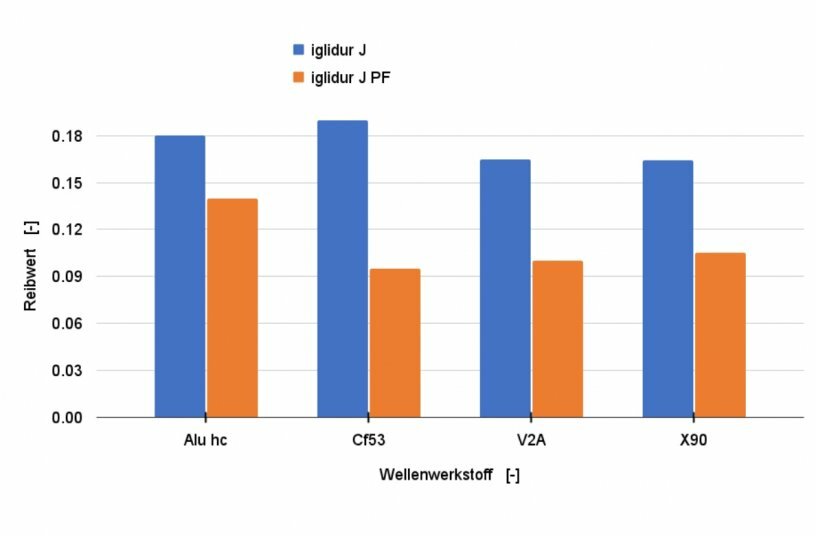
In Picture 4, this can be seen very clearly in the coefficient of friction in the rotating movement of plain bearing bushings under a load of 1MPa. The coefficient of friction is a measure of the frictional force without dimensions in relation to the contact pressure between two bodies. In this case between the iglidur plain bearing and the metal shaft. The bar chart clearly illustrates the improved coefficient of friction of the newly developed iglidur J PF product version compared to the proven iglidur J variant containing PTFE. Research into alternatives has provided significant added value here. A similar pattern can be seen in the wear of the plain bearing bushings. This is shown in Picture 5.
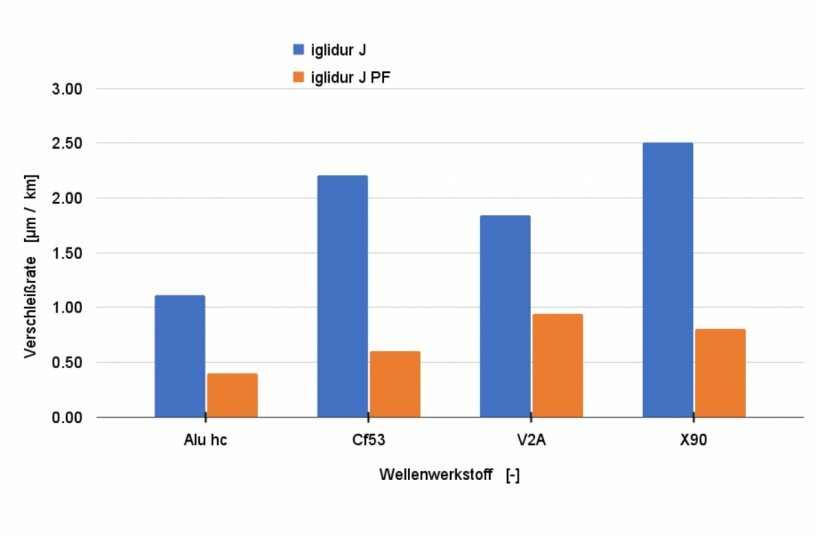
In the wear test, the plain bearing bushings is measured before submitted to a load and after a defined test period. The wear per 1,000m of running performance determines the wear rate and is ultimately a measure of how long products can be used in the application. The results show that the already good wear rates are reduced by an average of approx. 60 % due to the new development of the PTFE substitution.
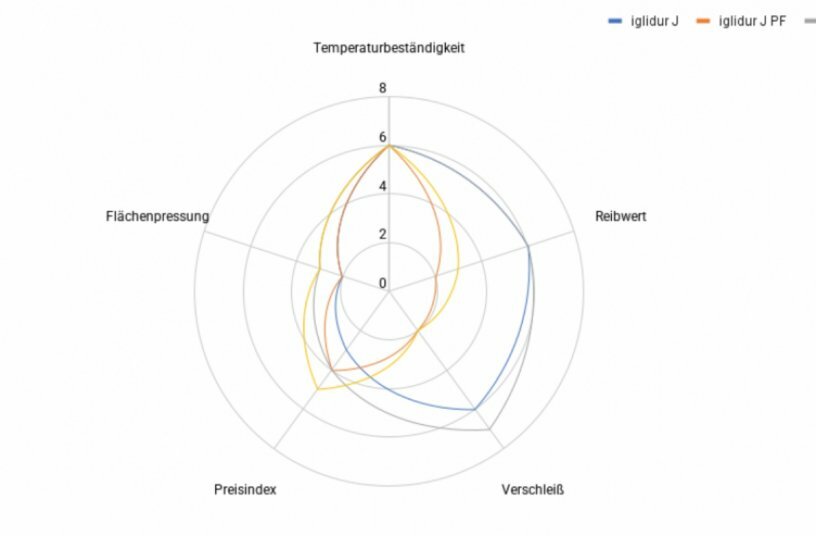
The clever design of the formulations means that the other known material specifications in terms of temperature stability, mechanical strength and shrinkage behaviour remain almost the same. The radar chart of the specifications in Picture 6 also shows that products made from PTFE-free materials are still around 10% more expensive than the familiar products containing fluorine. This is due to the different purchasing volumes. If demand for PTFE-free alternatives increases, raw materials can be sourced more cheaply and larger batches can be compounded. This will affect the difference in the selling price of the products.
Free from PFAS and PTFE
Even today, over 75% of the igus products sold can be offered without PTFE. The material developers are currently working on further alternatives, particularly for highly reinforced plastics from the igus material range. The company will also be presenting new PTFE-free products at the upcoming Hannover Messe in March 2025.
Alongside the further development of the materials, many materials are analysed for additional PFAS in external test laboratories. igus customers not only request PTFE-free products, but also want to ensure that the materials do not contain any other substances that are on the ECHA's potential list of banned substances. This is still difficult from both a metrological and legal point of view. The term "PTFE-free" is not clearly defined and there are no definite rules as to what may be present in what proportions. Also, only slightly more than 100 PFAS can currently be measured in the test laboratories of the igus partners. Regardless of the outcome of the political and public debate on the PFAS ban, igus will be able to offer a large number of products that are PFAS-free on the basis of the measurable substances in which no perfluorinated and polyfluorinated alkyl substances have been actively added. With the courage to innovate and a commitment to sustainability, igus is paving the way to a smooth and environmentally friendly future for technical plastics.
Source: igus GmbH
Set LECTURA Press as your preferred source

